The Keksec threat actor has been linked to a previously
undocumented malware strain, which has been observed in the wild
masquerading as an extension for Chromium-based web browsers to
enslave compromised machines into a botnet.
Called Cloud9 by security firm Zimperium, the
malicious browser add-on comes with a wide range of features that
enables it to siphon cookies, log keystrokes, inject arbitrary
JavaScript code, mine crypto, and even enlist the host to carry out
DDoS attacks.
The extension “not only steals the information available during
the browser session but can also install malware on a user’s device
and subsequently assume control of the entire device,” Zimperium
researcher Nipun Gupta said[1]
in a new report.
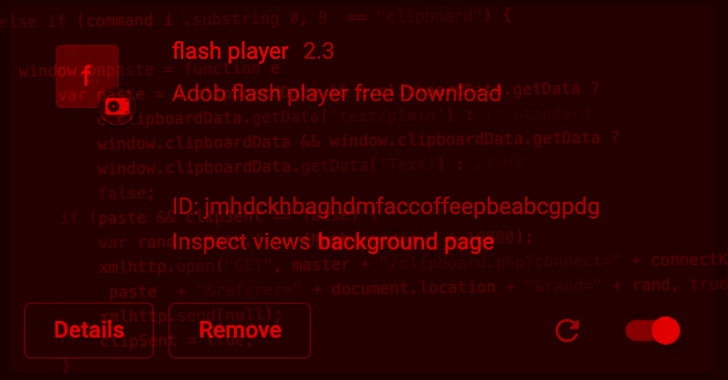
The JavaScript botnet isn’t distributed via Chrome Web Store or
Microsoft Edge Add-ons, but rather through fake executables and
rogue websites disguised as Adobe Flash Player updates.
Once installed, the extension is designed to inject a JavaScript
file called “campaign.js” on all pages, meaning the malware could
also operate as a standalone piece of code on any website,
legitimate or otherwise, potentially leading watering hole
attacks.
The JavaScript code takes responsibility for cryptojacking
operations, abusing the victim’s computing resources to illicitly
mine cryptocurrencies, as well as inject a second script named
“cthulhu.js.”
This attack chain, in turn, exploits flaws in web browsers such
as Mozilla Firefox (CVE-2019-11708[2], CVE-2019-9810[3]), Internet Explorer
(CVE-2014-6332[4], CVE-2016-0189[5]), and Edge (CVE-2016-7200[6]) to escape the browser
sandbox and deploy malware on the system.
The script further acts as a keylogger and a conduit for
launching additional commands received from a remote server,
allowing it to steal clipboard data, browser cookies, and launching
layer 7 DDoS attacks[7]
against any domain.
Zimperium attributed the malware to a threat actor tracked as
Keksec[8]
(aka Kek Security, Necro, and FreakOut), which has a history of
developing a wide range of botnet malware, including EnemyBot[9], for crypto mining and
DDoS operations.
The connection to Keksec comes from overlaps in the domains that
were previously identified as used by the malware group.
The fact that Cloud9 is JavaScript-based and is offered either
for free or a small fee on hacker forums makes it possible for
less-skilled cybercriminals to get easy access to low-cost options
for launching attacks targeting different browsers and operating
systems.
The disclosure comes over three months after Zimperium
discovered a malicious browser add-on dubbed ABCsoup[10] that posed as a Google
Translate tool to strike Russian users of Google Chrome, Opera, and
Mozilla Firefox browsers.
“Users should be trained on the risks associated with browser
extensions outside of official repositories, and enterprises should
consider what security controls they have in place for such risks,”
Gupta said.
References
- ^
said
(www.zimperium.com) - ^
CVE-2019-11708
(nvd.nist.gov) - ^
CVE-2019-9810
(nvd.nist.gov) - ^
CVE-2014-6332
(nvd.nist.gov) - ^
CVE-2016-0189
(nvd.nist.gov) - ^
CVE-2016-7200
(nvd.nist.gov) - ^
layer 7
DDoS attacks (www.cloudflare.com) - ^
Keksec
(thehackernews.com) - ^
EnemyBot
(thehackernews.com) - ^
ABCsoup
(thehackernews.com)
Read more https://thehackernews.com/2022/11/experts-warn-of-browser-extensions.html