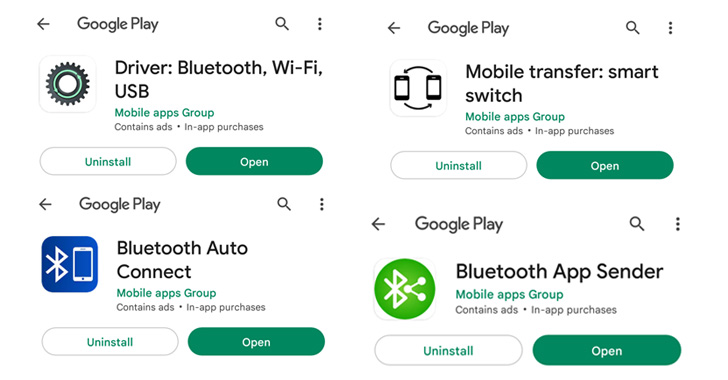
A set of four Android apps released by the same developer has
been discovered directing victims to malicious websites as part of
an adware and information-stealing campaign.
The apps, published by a developer named Mobile apps Group[1]
and currently available on the Play Store, have been collectively
downloaded over one million times.
According to Malwarebytes[2], the websites are
designed to generate revenues through pay-per-click ads, and worse,
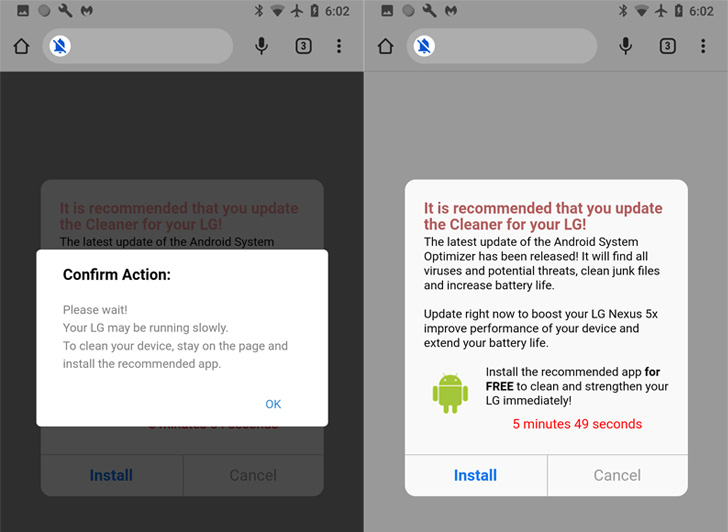
prompt users to install cleaner apps on their phones with the goal
of deploying additional malware.
The list of apps is as follows –
- Bluetooth App Sender (com.bluetooth.share.app) – 50,000+
downloads - Bluetooth Auto Connect (com.bluetooth.autoconnect.anybtdevices)
– 1,000,000+ downloads - Driver: Bluetooth, Wi-Fi, USB
(com.driver.finder.bluetooth.wifi.usb) – 10,000+ downloads - Mobile transfer: smart switch
(com.mobile.faster.transfer.smart.switch) – 1,000+ downloads
It’s no surprise that malicious apps have devised new ways[3]
to get past Google Play Store security protections. One of the more
popular tactics adopted by threat actors is to introduce time-based
delays to conceal their malicious behavior.
Malwarebytes’ analysis found the apps to have an approximately
four-day waiting period before opening the first phishing site in
Chrome browser, and then proceed to launch more tabs every two
hours.
The apps are part of a broader[4]
malware[5]
operation[6]
called HiddenAds[7], which has been active
since at least June 2019 and has a track record of illicitly
earning revenues by redirecting users to advertisements.
The findings also come as researchers from Guardio Labs
disclosed details of a malvertising campaign dubbed Dormant Colors[8]
that leverages rogue Google Chrome and Microsoft Edge extensions to
hijack user search queries to an actor-controlled domain.
References
- ^
Mobile
apps Group (play.google.com) - ^
Malwarebytes
(www.malwarebytes.com) - ^
devised
new ways (thehackernews.com) - ^
broader
(thehackernews.com) - ^
malware
(thehackernews.com) - ^
operation
(www.malwarebytes.com) - ^
HiddenAds
(malpedia.caad.fkie.fraunhofer.de) - ^
Dormant
Colors (guardiosecurity.medium.com)
Read more https://thehackernews.com/2022/11/these-android-apps-with-million-play.html