A now-patched security flaw in Apple’s iOS and macOS operating
systems could have potentially enabled apps with Bluetooth access
to eavesdrop on conversations with Siri.
Apple said “an app may be able to record audio using a pair of
connected AirPods,” adding it addressed the Core Bluetooth issue in
iOS 16.1 with improved entitlements.
Credited with discovering and reporting the bug in August 2022
is app developer Guilherme Rambo. The bug, dubbed
SiriSpy, has been assigned the identifier
CVE-2022-32946.
“Any app with access to Bluetooth could record your
conversations with Siri and audio from the iOS keyboard dictation
feature when using AirPods or Beats headsets,” Rambo said[1]
in a write-up.
“This would happen without the app requesting microphone access
permission and without the app leaving any trace that it was
listening to the microphone.”
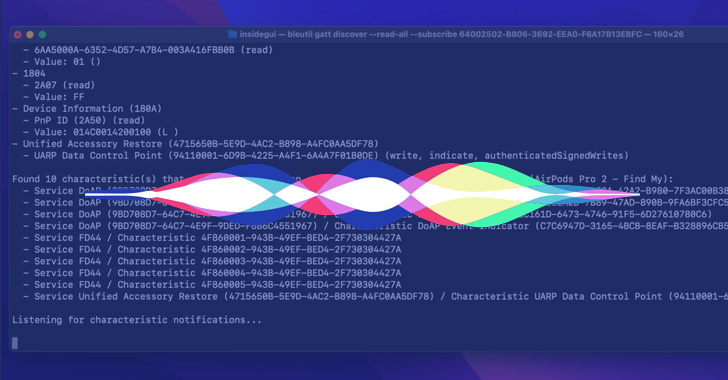
The vulnerability, according to Rambo, relates to a service
called DoAP that’s included in AirPods for Siri and Dictation
support, thereby enabling a malicious actor to craft an app that
could be connected to the AirPods via Bluetooth and record the
audio in the background.
This is compounded by the fact that “there’s no request to
access the microphone, and the indication in Control Center only
lists ‘Siri & Dictation,’ not the app that was bypassing the
microphone permission by talking directly to the AirPods over
Bluetooth LE.”
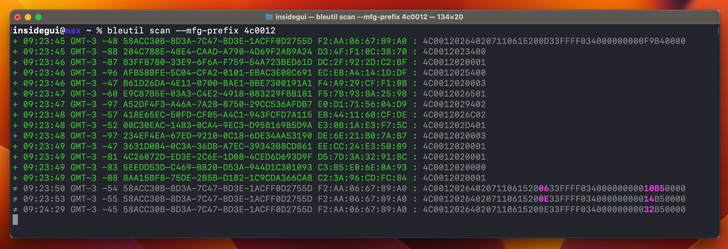
While the attack requires that the app has access to Bluetooth,
this restriction can be trivially bypassed as users granting
Bluetooth access to the app are unlikely to expect that it could
also open the door to accessing their conversations with Siri and
audio from dictation.
On macOS, however, the exploit could be abused to achieve a
total bypass of the Transparency, Consent and Control (TCC[2]) security framework,
meaning any app can record conversations with Siri without
requesting for any permissions in the first place.
Rambo said the reason for this behavior is owing to the lack of
entitlement checks for BTLEServerAgent, the daemon service
responsible for handling DoAP audio.
A software patch[3]
remediating this flaw is available for iPhone 8 and later, iPad Pro
(all models), iPad Air 3rd generation and later, iPad 5th
generation and later, and iPad mini 5th generation and later. It
has also been resolved in all supported
versions[4] of macOS.
The iOS 16.1 update, which was released on October 24, 2022,
comes with fixes for a total of 20 flaws, including a Kernel vulnerability[5]
(CVE-2022-42827) that it disclosed as being actively exploited in
the wild.
References
- ^
said
(rambo.codes) - ^
TCC
(www.sentinelone.com) - ^
software
patch (support.apple.com) - ^
supported versions
(support.apple.com) - ^
Kernel
vulnerability (thehackernews.com)
Read more https://thehackernews.com/2022/10/apple-ios-and-macos-flaw-couldve-let.html