
A new cryptojacking campaign has been uncovered targeting
vulnerable Docker and Kubernetes infrastructures as part of
opportunistic attacks designed to illicitly mine
cryptocurrency.
Cybersecurity company CrowdStrike dubbed the activity
Kiss-a-dog, with its command-and-control
infrastructure overlapping with those associated with other groups
like TeamTNT[1], which are known to
strike[2]
misconfigured[3]
Docker and Kubernetes instances.
The intrusions, spotted in September 2022, get their name from a
domain named “kiss.a-dog[.]top” that’s used to trigger a shell
script payload on the compromised container using a Base64-encoded
Python command.
“The URL used in the payload is obscured with backslashes to
defeat automated decoding and regex matching to retrieve the
malicious domain,” CrowdStrike researcher Manoj Ahuje said[4]
in a technical analysis.
The attack chain subsequently attempts to escape the container
and move laterally into the breached network, while simultaneously
taking steps to terminate and remove cloud monitoring services.
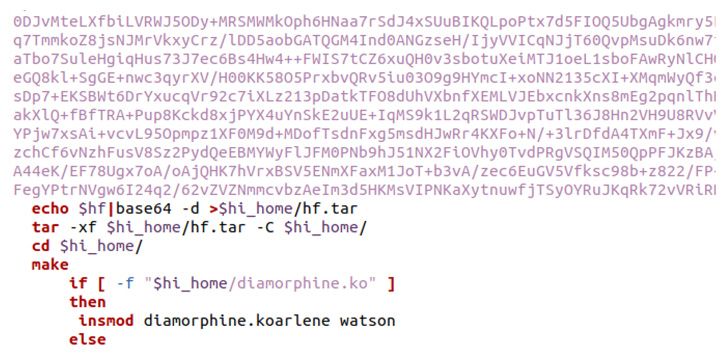
As additional methods to evade detection, the campaign makes use
of the Diamorphine[5]
and libprocesshide[6]
rootkits to hide malicious processes from the user, the latter of
which is compiled as a shared library and its path[7]
is set as the value for the LD_PRELOAD[8]
environment variable.
“This allows the attackers to inject malicious shared libraries
into every process spawned on a compromised container,” Ahuje
said.
The ultimate goal of the campaign is to stealthily mine
cryptocurrency using the XMRig mining software as well as to
backdoor Redis and Docker instances for mining and other follow-on
attacks.
“As cryptocurrency prices have dropped, these campaigns have
been muffled in the past couple of months until multiple campaigns
were launched in October to take advantage of a low competitive
environment,” Ahuje noted.
The findings also come as researchers from Sysdig took the wraps
off another sophisticated crypto mining operation dubbed
PURPLEURCHIN, which leverages the compute allocated for free trial
accounts across GitHub, Heroku, and Buddy[.]Works to scale the
attacks.
As many as 30 GitHub accounts, 2,000 Heroku accounts, and 900
Buddy accounts are said to have been utilized in the automated
freejacking campaign.
The attack entails the creation of an actor-controlled GitHub
account, each containing a repository that, in turn, has a GitHub Action[9]
to run mining operations by launching a Docker Hub image.
“Using free accounts shifts the cost of running the cryptominers
to the service provider,” the researchers said[10]. “However, like many
fraud-use cases, the abuse of free accounts can affect others.
Higher expenses for the provider will lead to higher prices for its
legitimate customers.”
References
- ^
TeamTNT
(thehackernews.com) - ^
strike
(thehackernews.com) - ^
misconfigured
(www.trendmicro.com) - ^
said
(www.crowdstrike.com) - ^
Diamorphine
(github.com) - ^
libprocesshide
(github.com) - ^
path
(en.wikipedia.org) - ^
LD_PRELOAD
(www.cadosecurity.com) - ^
GitHub
Action (thehackernews.com) - ^
said
(sysdig.com)
Read more https://thehackernews.com/2022/10/new-cryptojacking-campaign-targeting.html