
The operators behind the BazaCall call back phishing method have
continued to evolve with updated social engineering tactics to
deploy malware on targeted networks.
The scheme eventually acts as an entry point to conduct
financial fraud or the delivery of next-stage payloads such as
ransomware, cybersecurity company Trellix said[1]
in a report published last week.
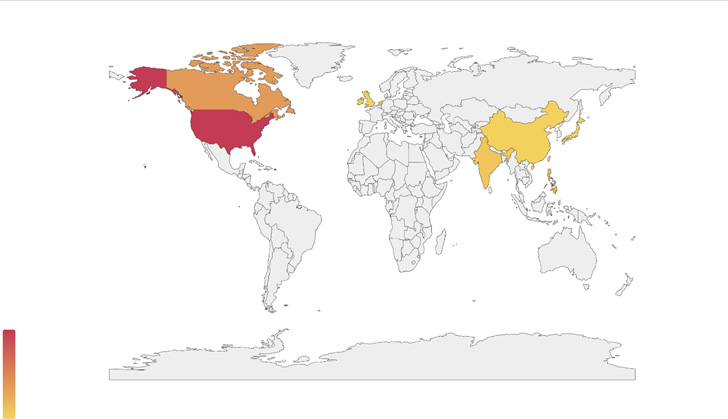
Primary targets of the latest attack waves include the U.S.,
Canada, China, India, Japan, Taiwan, the Philippines, and the
U.K.
BazaCall[2], also called BazarCall,
first gained popularity in 2020 for its novel approach of
distributing the BazarBackdoor (aka BazarLoader) malware by
manipulating potential victims into calling a phone number
specified in decoy email messages.
These email baits aim to create a false sense of urgency,
informing the recipients about renewal of a trial subscription for,
say, an antivirus service. The messages also urge them to contact
their support desk to cancel the plan, or risk getting
automatically charged for the premium version of the software.
The ultimate goal of the attacks is to enable remote access to
the endpoint under the guise of terminating the supposed
subscription or installing a security solution to rid the machine
of malware, effectively paving the way for follow-on
activities.
Another tactic embraced by the operators involves masquerading
as incident responders in PayPal-themed campaigns to deceive the
caller into thinking that their accounts were accessed from eight
or more devices spread across random locations across the
world.
Regardless of the scenario employed, the victim is prompted to
launch a specific URL – a specially crafted website designed to
download and execute a malicious executable that, among other
files, also drops the legitimate ScreenConnect remote desktop
software.
A successful persistent access is followed by the attacker
opening fake cancellation forms that ask the victims to fill out
personal details and sign in to their bank accounts to complete the
refund, but in reality are fooled into sending the money to the
scammer.
The development comes as at least three different spinoff groups[3] from the Conti
ransomware cartel have embraced the call back phishing technique as
an initial intrusion vector to breach enterprise networks.
The ties to Conti don’t end there. BazarBackdoor[4], for its part, is the
creation of a cybercrime group known as TrickBot[5], which was taken over[6]
by Conti[7]
earlier this year before the latter’s shutdown[8]
in May-June 2022 over its allegiance to Russia in its assault on
Ukraine.
References
- ^
said
(www.trellix.com) - ^
BazaCall
(thehackernews.com) - ^
three
different spinoff groups
(thehackernews.com) - ^
BazarBackdoor
(abnormalsecurity.com) - ^
TrickBot
(www.cyjax.com) - ^
taken
over (thehackernews.com) - ^
Conti
(intel471.com) - ^
latter’s
shutdown (thehackernews.com)
Read more https://thehackernews.com/2022/10/bazarcall-callback-phishing-attacks.html