
The Emotet malware is now being leveraged by
ransomware-as-a-service (RaaS) groups, including Quantum and
BlackCat, after Conti’s official retirement[1] from the threat
landscape this year.
Emotet[2]
started off as a banking trojan in 2014, but updates added to it
over time have transformed the malware into a highly potent threat
that’s capable of downloading other payloads onto the victim’s
machine, which would allow the attacker to control it remotely.
Although the infrastructure associated with the invasive malware
loader was taken down as part of a law enforcement effort in
January 2021, the Conti ransomware cartel is said to have played an instrumental role[3] in its comeback late
last year.
“From November 2021 to Conti’s dissolution in June 2022, Emotet
was an exclusive Conti ransomware tool, however, the Emotet
infection chain is currently attributed to Quantum and BlackCat,”
AdvIntel said[4]
in an advisory published last week.
Typical attack sequences entail the use of Emotet (aka SpmTools)
as an initial access vector to drop Cobalt Strike, which then is
used as a post-exploitation tool for ransomware operations.
The notorious Conti ransomware gang may have dissolved, but
several of its members remain as active as ever either as part of
other ransomware crews like BlackCat[5]
and Hive[6]
or as independent groups focused on data extortion[7]
and other criminal endeavors.
Quantum is also a Conti spin-off group that, in the intervening
months, has resorted to the technique of call-back phishing –
dubbed BazaCall[8]
or BazarCall – as a means to breach targeted networks.
“Conti affiliates use a variety of initial access vectors
including phishing, compromised credentials, malware distribution,
and exploiting vulnerabilities,” Recorded Future noted[9]
in a report published last month.
AdvIntel said it observed over 1,267,000 Emotet infections
across the world since the start of the year, with activity peaks
registered in February and March coinciding with Russia’s invasion
of Ukraine.
A second surge in infections occurred between June and July,
owing to the use by ransomware groups such as Quantum and BlackCat.
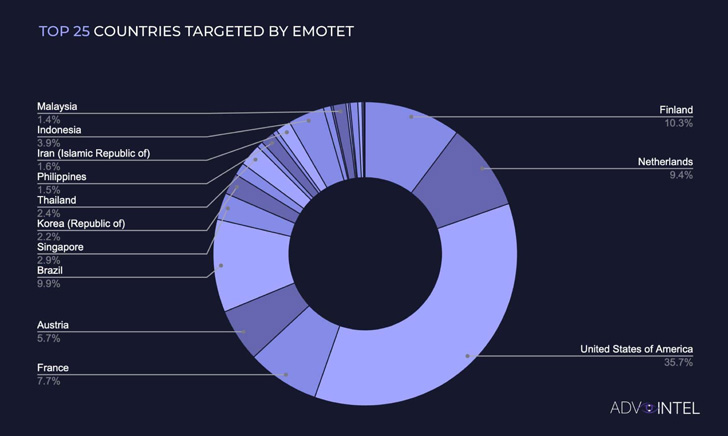
Data captured by the cybersecurity firm shows that the most
Emotet-targeted country is the U.S., followed by Finland, Brazil,
the Netherlands, and France.
ESET previously reported[10] a 100-fold jump in
Emotet detections during the first four months of 2022 in
comparison to the preceding four months from September to December
2021.
According to Israeli cybersecurity company Check Point, Emotet
dropped[11] from first to fifth
place in the list of most prevalent malware for August 2022, coming
behind FormBook, Agent Tesla, XMRig, and GuLoader.
References
- ^
Conti’s
official retirement (thehackernews.com) - ^
Emotet
(thehackernews.com) - ^
played
an instrumental role (thehackernews.com) - ^
said
(advintel.io) - ^
BlackCat
(thehackernews.com) - ^
Hive
(thehackernews.com) - ^
data
extortion (thehackernews.com) - ^
BazaCall
(thehackernews.com) - ^
noted
(www.recordedfuture.com) - ^
previously reported
(thehackernews.com) - ^
dropped
(www.checkpoint.com)
Read more https://thehackernews.com/2022/09/emotet-botnet-started-distributing.html