
An ongoing espionage campaign operated by the Russia-linked
Gamaredon group is targeting employees of Ukrainian government,
defense, and law enforcement agencies with a piece of custom-made
information stealing malware.
“The adversary is using phishing documents containing lures
related to the Russian invasion of Ukraine,” Cisco Talos
researchers Asheer Malhotra and Guilherme Venere said[1]
in a technical write-up shared with The Hacker News. “LNK files,
PowerShell, and VBScript enable initial access, while malicious
binaries are deployed in the post-infection phase.”
Active since 2013, Gamaredon – also known as Actinium,
Armageddon, Primitive Bear, Shuckworm, and Trident Ursa – has been
linked to numerous attacks aimed at Ukrainian entities in the
aftermath of Russia’s military invasion of Ukraine in late February
2022.
The targeted phishing operation, observed as recently as August
2022, also follows similar intrusions uncovered[2]
by Symantec last month involving the use of malware such as Giddome
and Pterodo. The primary goal of these attacks is to establish
long-term access for espionage and data theft.
It entails leveraging decoy Microsoft Word documents containing
lures related to the Russian invasion of Ukraine distributed via
email messages to infect targets. When opened, macros concealed
within remote templates are executed to retrieve RAR containing LNK
files.
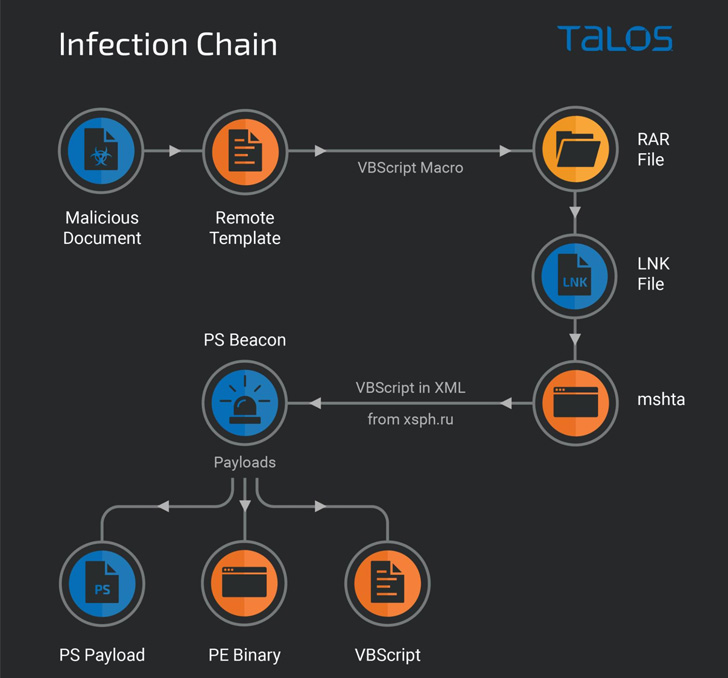
The LNK files seemingly reference intelligence briefings related
to the Russian invasion of Ukraine to trick unsuspecting victims
into opening the shortcuts, resulting in the execution of a
PowerShell beacon script that ultimately paves the way for
next-stage payloads.
This includes another PowerShell script that’s used to provide
persistent access to compromised system and deliver additional
malware, including a new malware capable of plundering files (.doc,
.docx, .xls, .rtf, .odt, .txt, .jpg, .jpeg, .pdf, .ps1, .rar, .zip,
.7z, and .mdb) from the machine as well as any removable drive
connected to it.
“The infostealer is a dual-purpose malware that includes
capabilities for exfiltrating specific file types and deploying
additional binary and script-based payloads on an infected
endpoint,” the researchers said, adding it may be a component of
the Giddome backdoor family[3].
The findings come at a time cyberattacks continue to be an
important part of modern hybrid war strategy amidst the conflict
between Russia and Ukraine. Earlier this month, Google’s Threat
Analysis Group (TAG) disclosed[4]
as many as five different campaigns mounted by a group with links
to the Conti cybercrime cartel.
References
Read more https://thehackernews.com/2022/09/russian-gamaredon-hackers-target.html