Hackers tied to the Iranian government have been targeting
individuals specializing in Middle Eastern affairs, nuclear
security and genome research as part of a new social engineering
campaign designed to hunt for sensitive information.
Enterprise security firm attributed the targeted attacks to a
threat actor named TA453[1], which broadly overlaps
with cyber activities monitored under the monikers APT42, Charming
Kitten, and Phosphorus.
It all starts with a phishing email impersonating legitimate
individuals at Western foreign policy research organizations that’s
ultimately designed to gather intelligence on behalf of Iran’s
Islamic Revolutionary Guard Corps (IRGC).
Spoofed personas include people from Pew Research Center, the
Foreign Policy Research Institute (FRPI), the U.K.’s Chatham House,
and the scientific journal Nature. The technique is said to have
been deployed in mid-June 2022.
What’s different from other phishing attacks is the use of a
tactic Proofpoint calls Multi-Persona Impersonation (MPI), wherein
the threat actor employs not one but several actor-controlled
personas in the same email conversation to bolster the chances of
success.
The idea is to “leverage the psychology principle of social proof[2]” and increase the
authenticity of the threat actor’s correspondence so as to make the
target buy into the scheme, a tactic that demonstrates the
adversary’s continued ability to step up its game.
“This is an intriguing technique because it requires more
resources to be used per target – potentially burning more personas
– and a coordinated approach among the various personalities in use
by TA453,” Sherrod DeGrippo, vice president of threat research and
detection at Proofpoint, said[3]
in a statement.
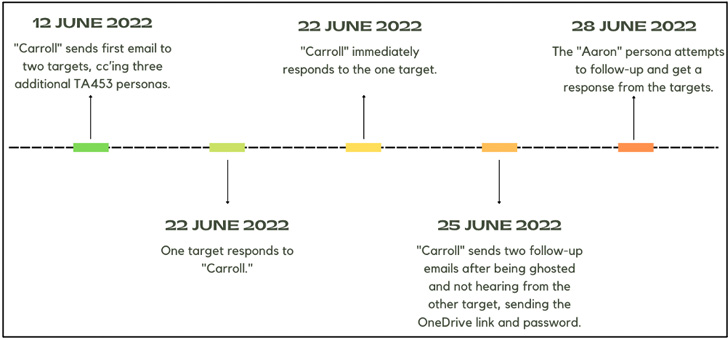
Once the initial email elicits a response from the target, the
persona then sends a follow-up message containing a malicious
OneDrive link that downloads a Microsoft Office document, one of
which purportedly alludes to a clash between Russia and the
U.S.
This document subsequently uses a technique called remote template injection[4] to download Korg, a
template consisting of three macros that are capable of gathering
usernames, a list of running processes, and the victims’ public IP
addresses.
Besides the exfiltration of the beaconing information, no other
post-exploitation actions have been observed. The “abnormal” lack
of code execution and command-and-control behavior has led to an
assessment that the compromised users may be subjected to further
attacks based on the installed software.
This is not the first time the threat actor has undertaken
impersonation campaigns. In July 2021, Proofpoint revealed a
phishing operation dubbed SpoofedScholars[5]
that targeted individuals focused on Middle East affairs in the
U.S. and the U.K. under the guise of scholars with the University
of London’s School of Oriental and African Studies (SOAS).
Then in July 2022, the cybersecurity company uncovered attempts[6]
on the part of TA453 to masquerade as journalists to lure academics
and policy experts into clicking on malicious links that redirect
the targets to credential harvesting domains.
The disclosure comes amid a flurry of Iranian-linked cyber
activity. Last week, Microsoft took the wraps off a string of ransomware attacks[7] mounted by a Phosphorus
subgroup dubbed DEV-0270 using living-off-the-land binaries such as
BitLocker.
Additionally, cybersecurity firm Mandiant, which is now officially part of Google Cloud[8], detailed the activities
of an Iranian espionage actor codenamed APT42[9]
that has been linked to over 30 operations since 2015.
To top it all, the Treasury Department announced sanctions[10] against Iran’s Ministry
of Intelligence and Security (MOIS) and its Minister of
Intelligence, Esmaeil Khatib, in response to “cyber-enabled
activities against the United States and its allies.”
Albania, which has severed diplomatic relations with Iran after
blaming it for a series of cyber offensives since July, pointed fingers[11] at the “same
aggressors” over the weekend for conducting another attack on a
government system used to track border crossings.
“State-aligned threat actors are some of the best at crafting
well thought-out social engineering campaigns to reach their
intended victims,” DeGrippo said.
“Researchers involved in international security, particularly
those specializing in Middle Eastern studies or nuclear security,
should maintain a heightened sense of awareness when receiving
unsolicited emails.”
References
- ^
TA453
(thehackernews.com) - ^
social
proof (en.wikipedia.org) - ^
said
(www.proofpoint.com) - ^
remote
template injection (attack.mitre.org) - ^
SpoofedScholars
(thehackernews.com) - ^
uncovered attempts
(thehackernews.com) - ^
string
of ransomware attacks (thehackernews.com) - ^
officially part of Google Cloud
(www.mandiant.com) - ^
APT42
(thehackernews.com) - ^
announced sanctions
(thehackernews.com) - ^
pointed fingers
(twitter.com)
Read more https://thehackernews.com/2022/09/iranian-hackers-target-high-value.html