Imagine this: a company-wide lockout to the company CRM, like
Salesforce, because the organization’s external admin attempts to
disable MFA for themselves. They don’t think to consult with the
security team and don’t consider the security implications, only
the ease which they need for their team to use their login.
This CRM, however, defines MFA as a top-tier security setting;
for example, Salesforce has a “High Assurance Login Value”
configuration and immediately locks out all users as a safety
precaution. The entire organization hits a standstill and is
frustrated and confused.
Deeply concerning, this is not a one-off event, admins for
business-critical SaaS apps often sit outside the security
department and have profound control. Untrained and not focused on
security measures, these admins are working towards their
departmental KPIs. For instance, Hubspot is usually owned by the
marketing department, likewise, Salesforce is often owned by the
business department, etc. Business departments own these apps
because it’s what allows them to do their job efficiently. However,
the paradox lies in the fact that it’s the security team’s
responsibility to secure the organization’s SaaS app stack and they
cannot effectively execute this task without full control of the
SaaS app.
The 2022 SaaS Security Survey Report[1], run by CSA and Adaptive
Shield, delves into the reality of this paradox, presenting data
from CISOs and security professionals today. This article will
explore important data points from the respondents and discuss what
the solution for security teams could be.
Learn how your security teams can regain
control of all SaaS apps.[2]
SaaS Apps in the Hands of Business Departments
Across a typical organization, a wide array of SaaS apps are
used (see figure 1), from cloud data platforms, file sharing and
collaboration apps to CRM, project and work management, marketing
automation, and a whole lot more. The need for each and every SaaS
app fills a certain niche role required by the organization.
Without the use of all these SaaS apps, a business could find
itself lagging or taking more time to achieve its KPIs.
The 2022 SaaS Security Survey Report[3] reports that 40% of
these apps are managed and owned by non-security teams, such as
sales, marketing, legal, etc. (see in figure 2). While the security
and IT teams are reported to be the main destination for SaaS app
management, it’s the 40% of business departments also taking part
and having full access that complicates the threat landscape.
Security teams can’t take away this ownership as the business
applications’ owners need to maintain a high level of access to
their relevant SaaS apps for optimal use. Yet, without in-depth
knowledge of security or the vested interest (a security KPI that
reflects on their work product), it’s not reasonable for the
security team to expect that the business owner will ensure a high
level of security in their SaaS.
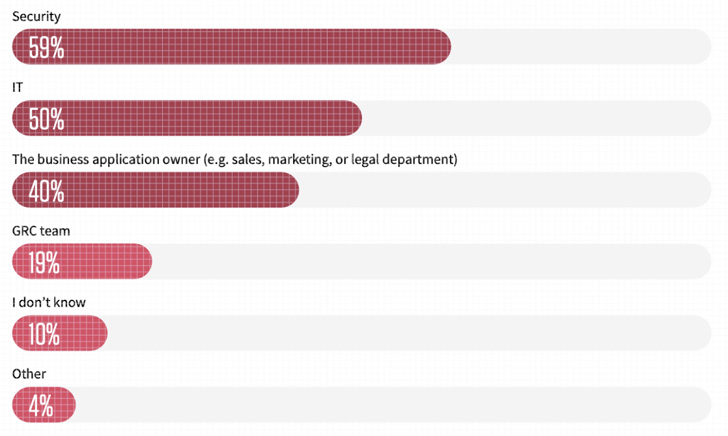 |
| Figure 2. Departments Managing SaaS apps, 2022 SaaS Security Survey Report |
Unpacking the SaaS App Ownership Paradox
When asked the main reason for misconfiguration-led security
incidents (figure 3), respondents of the survey report cited these
at their top four: (1) There are too many departments with access
to security settings; (2) Lack of visibility to security settings
when they are changed (3) Lack of SaaS security knowledge; (4)
Misappropriated user permissions. All of these reasons, either
overtly or implied, can be attributed to the SaaS App Ownership
Paradox.
The leading cause of security incidents caused by
misconfigurations is having too many departments with access to
security settings. This goes hand in hand with the next cause –
lack of visibility when security changes are changed. A business
department may make changes to an app setting to optimize its ease
of use without consulting with or notifying the security
department.
In addition, misappropriated user permissions can easily stem
from a business department owner at the helm who is not paying
careful attention to the app’s security. Often users are granted
privileged permissions that they don’t even need.
How Security Teams Can Regain Control
With this shared responsibility model, the only efficient way to
bridge this communication gap is through a SaaS Security Posture
Management platform (SSPM). Hailed as a MUST HAVE solution to
continuously assess security risks and manage the SaaS
applications’ security posture in the “4 Must-Have Technologies
That Made the Gartner Hype Cycle for Cloud Security, 2021”, such a
solution can alert the security team on any app configuration
change made by the app owner, and provide clear directions on how
to fix it through a ticketing or collaboration management
system.
With an SSPM solution, owned and managed by the organization’s
security team, the security team can gain complete visibility of
all the company’s SaaS apps and their security settings, including
user roles and permissions. W
Organizations can take it one step further and have the app
owners join the SSPM platform so they can actively control and
oversee all configurations in their owned apps. By using a scoped
admin capability (figure 4) the security team can grant the app
owners access to the apps they own and can remediate security
issues, with their supervision and direction.
There’s no way to eliminate business departments’ access to SaaS
app security settings, and while users across the organization
should be educated on basic SaaS security in order to reduce the
risk that may occur from business departments, it doesn’t always
happen or it’s just not enough. Organizations need to implement a
solution that helps avoid these situations by enabling visibility
and control for the security team, alerting on configuration
drifts, audit logs that provide insight into actions within the
SaaS apps and scoped admins.
Get a 10-minute demo of how Adaptive
Shield’s SSPM solution helps security teams regain
control.[4]
References
- ^
2022
SaaS Security Survey Report
(www.adaptive-shield.com) - ^
Learn
how your security teams can regain control of all SaaS apps
(www.adaptive-shield.com) - ^
2022
SaaS Security Survey Report
(www.adaptive-shield.com) - ^
Get a
10-minute demo of how Adaptive Shield’s SSPM solution helps
security teams regain control.
(www.adaptive-shield.com)
Read more https://thehackernews.com/2022/08/who-has-control-saas-app-admin-paradox.html