
Threat actors are increasingly abusing Internet Information
Services (IIS[1]) extensions to backdoor
servers as a means of establishing a “durable persistence
mechanism.”
That’s according to a new warning[2]
from the Microsoft 365 Defender Research Team, which said that “IIS
backdoors are also harder to detect since they mostly reside in the
same directories as legitimate modules used by target applications,
and they follow the same code structure as clean modules.”
Attack chains taking this approach commence with weaponizing a
critical vulnerability in the hosted application for initial
access, using this foothold to drop a script web shell as the first
stage payload.
This web shell then becomes the conduit for installing a rogue
IIS module to provide highly covert and persistent access to the
server, in addition to monitoring incoming and outgoing requests as
well as running remote commands.
Indeed, earlier this month, Kaspersky researchers disclosed a
campaign undertaken by the Gelsemium group, which was found taking
advantage of the ProxyLogon Exchange Server flaws to launch a piece
of IIS malware called SessionManager[3].
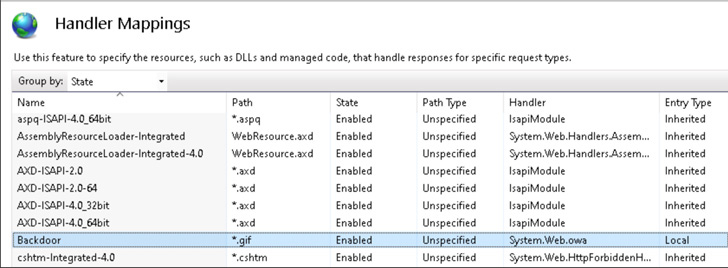
In another set of attacks observed by the tech giant between
January and May 2022, Exchange servers were targeted with web
shells by means of an exploit for the ProxyShell[4]
flaws, which ultimately led to the deployment of a backdoor called
“FinanceSvcModel.dll” but not before a period of
reconnaissance.
“The backdoor had built-in capability to perform Exchange
management operations, such as enumerating installed mailbox
accounts and exporting mailboxes for exfiltration,” security
researcher Hardik Suri explained.
To mitigate such attacks, it’s recommended to apply the latest
security updates for server components as soon as possible, keep
antivirus and other protections enabled, review sensitive roles and
groups, and restrict access by practicing the principle of
least-privilege and maintaining good credential hygiene.
References
- ^
IIS
(thehackernews.com) - ^
new
warning (www.microsoft.com) - ^
SessionManager
(thehackernews.com) - ^
ProxyShell
(thehackernews.com)
Read more https://thehackernews.com/2022/07/malicious-iis-extensions-gaining.html