
Typically, when threat actors look to infiltrate an
organization’s SaaS apps, they look to SaaS app misconfigurations
as a means of entry. However, employees now use their personal
devices, whether their phones or laptops, etc., to get their jobs
done. If the device’s hygiene is not up to par, it increases the
risk for the organization and widens the attack surface for bad
actors. And so, Endpoint (Device) Protection — through EDR, XDR,
and vulnerability management solutions – has arisen as a critical
factor in SaaS Security.
The challenge in remediating the threats posed by endpoints and
devices lies in the ability to correlate between the SaaS app
users, their roles, and permissions with their associated devices’
compliance and integrity levels. This end-to-end approach is what’s
needed for the organization to implement a holistic, zero-trust
approach for their SaaS Security.
Not a simple feat, however, automated SaaS Security Posture
Management solutions, like Adaptive Shield, can now provide
visibility that correlates the SaaS user and their associated
devices with the device’s hygiene score.
Click here to schedule a 10 min. demo to see
how you can secure your SaaS stack[1]
High-Risk Devices
How do you classify high-risk devices in the context of SaaS
security?
Devices that are owned, or used by users with high levels of
permission to the company’s core SaaS apps. For example, someone
who has high levels of access to the company’s CRM can present a
high risk to the company if their device is vulnerable and this
needs to be remediated immediately. These high-risk devices serve
as a critical threat vector to an organization’s SaaS
environment.
Security teams should continuously map devices to their users
and their associated permissions to get a handle on which
devices/users pose the highest risk.
Correlate Between User, App, and Device
As mentioned, the more privileged the user, the higher their
device is at risk. To gain deep observability into the user, app
and device posture, security teams need to check the hygiene of
their users’ devices, for example, up-to-date OS configurations,
and any vulnerabilities. With that assessment and score in hand,
security teams can map and monitor the user’s SaaS app access (in
addition to, of course, securing the SaaS apps themselves).
Once these cross-references are in place and accessible,
organizations can enable “soft” enforcement enhancements, through
policies and organizational best practices. This way security teams
can monitor risks and threats without severely limiting the
user.
Get the Zero Trust Approach
Zero-trust is a concept much batted about in cybersecurity
vernacular today. While many consider it a buzzword, its meaning
represents an important approach that can not be emphasized enough.
To wholly secure the organization’s SaaS stack, end-to-end, and
continuously, calls for a holistic and automated solution.
An SSPM solution, like Adaptive Shield[2], has been built to
resolve not only the need for management of the SaaS app
configurations themselves, but also the devices the organization’s
employees use. (Not to mention third party app access — and you can
read more about that here[3].) When integrated with
MDM (mobile device management) solution, Adaptive Shield will pull
the device data and map the device to the owner.
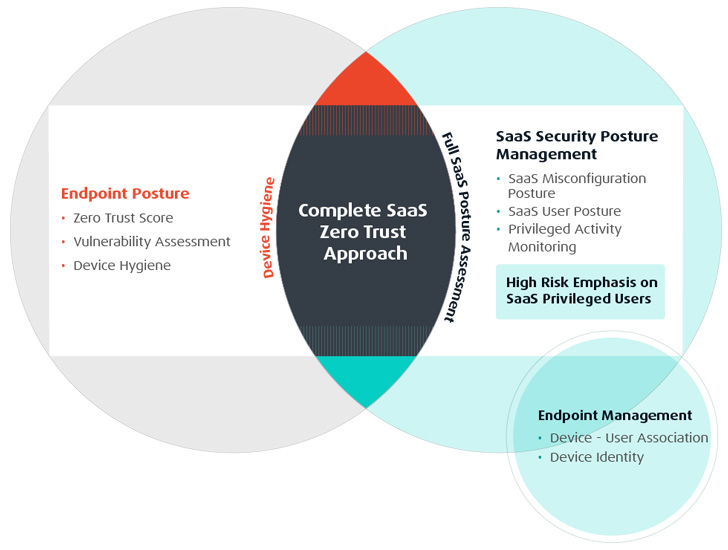
By looking at the device posture while conducting a SaaS
security assessment, organizations can achieve a holistic zero
trust approach.
Learn how to eliminate weak links in your
SaaS security now.[4]
References
- ^
Click
here to schedule a 10 min. demo to see how you can secure your SaaS
stack (www.adaptive-shield.com) - ^
Adaptive
Shield (www.adaptive-shield.com) - ^
here
(thehackernews.com) - ^
Learn
how to eliminate weak links in your SaaS security now.
(www.adaptive-shield.com)
Read more https://thehackernews.com/2022/07/the-new-weak-link-in-saas-security.html