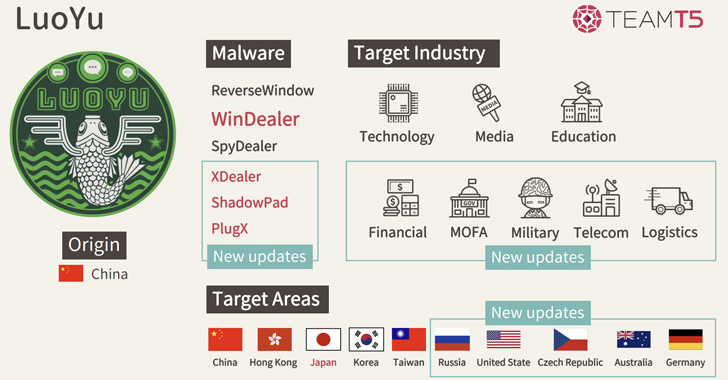
An “extremely sophisticated” Chinese-speaking advanced
persistent threat (APT) actor dubbed LuoYu has
been observed using a malicious Windows tool called WinDealer
that’s delivered by means of man-on-the-side attacks.
“This groundbreaking development allows the actor to modify
network traffic in-transit to insert malicious payloads,” Russian
cybersecurity company Kaspersky said[1]
in a new report. “Such attacks are especially dangerous and
devastating because they do not require any interaction with the
target to lead to a successful infection.”
Known to be active since 2008, organizations targeted by LuoYu
are predominantly foreign diplomatic organizations established in
China and members of the academic community as well as financial,
defense, logistics, and telecommunications companies.
LuoYu’s use of WinDealer[2]
was first documented by Taiwanese cybersecurity firm TeamT5[3]
at the Japan Security Analyst Conference (JSAC) in January 2021.
Subsequent attack campaigns[4]
have used the malware to target Japanese entities, with isolated
infections reported in Austria, Germany, India, Russia, and the
U.S.
Other tools that are part of the adversary’s malware arsenal
include PlugX[5]
and its successor ShadowPad[6], both of which have been
used by a variety of Chinese threat actors to enable their
strategic objectives. Additionally, the actor is known to target
Linux, macOS, and Android devices.
WinDealer, for its part, has been delivered in the past via
websites that act as watering holes[7]
and in the form of trojanized applications masquerading as instant
messaging and video hosting services like Tencent QQ and Youku.
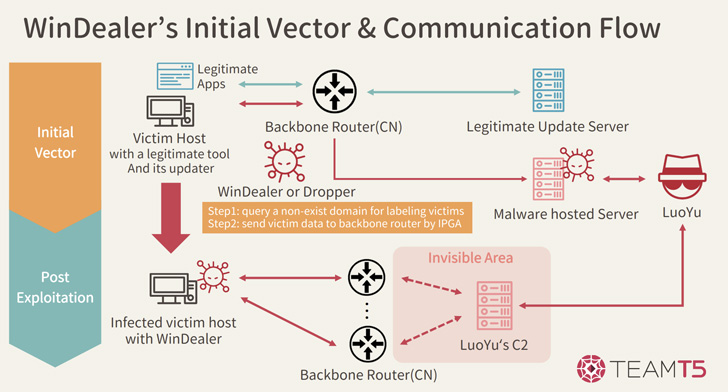
But the infection vector has since been traded for another
distribution method that makes use of the automatic update
mechanism of select legitimate applications to serve a compromised
version of the executable on “rare occasions.”
WinDealer, a modular malware platform at its core, comes with
all the usual bells and whistles associated with a backdoor,
allowing it to hoover sensitive information, capture screenshots,
and execute arbitrary commands.
But where it also stands apart is its use of an IP-generation
algorithm to select a command-and-control (C2) server to connect to
at random from a pool of 48,000 IP addresses.
“The only way to explain these seemingly impossible network
behaviors is by assuming the existence of a man-on-the-side
attacker who is able to intercept all network traffic and even
modify it if needed,” the company said.
A man-on-the-side[8]
attack, similar to a man-in-the-middle attack, enables a rogue
interloper to read and inject arbitrary messages into a
communications channel, but not modify or delete messages sent by
other parties.
Such intrusions typically bank on strategically timing their
messages such that the malicious reply containing the
attacker-supplied data is sent in response to a victim’s request
for a web resource before the actual response from the server.
The fact that the threat actor is able to control such a massive
range of IP addresses could also explain the hijacking of the
update mechanism associated with genuine apps to deliver the
WinDealer payload, Kaspersky pointed out.
“Man-on-the-side-attacks are extremely destructive as the only
condition needed to attack a device is for it to be connected to
the internet,” security researcher Suguru Ishimaru said.
“No matter how the attack has been carried out, the only way for
potential victims to defend themselves is to remain extremely
vigilant and have robust security procedures, such as regular
antivirus scans, analysis of outbound network traffic, and
extensive logging to detect anomalies.”
References
Read more https://thehackernews.com/2022/06/chinese-luoyu-hackers-using-man-on-side.html