Cybersecurity researchers have detailed a “simple but efficient”
persistence mechanism adopted by a relatively nascent malware
loader called Colibri, which has been observed deploying a
Windows information stealer known as Vidar as part of a new
campaign.
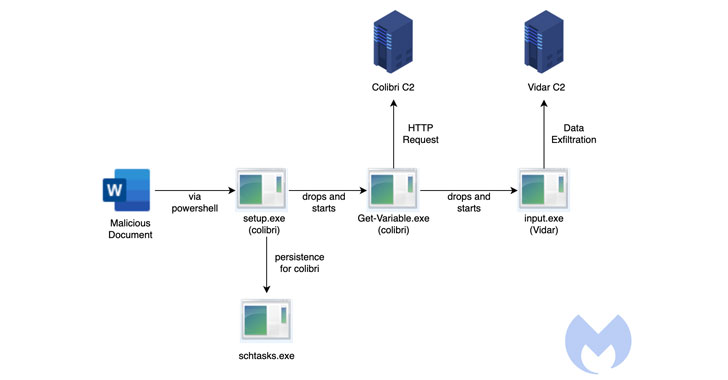
“The attack starts with a malicious Word document deploying a
Colibri bot that then delivers the Vidar Stealer,” Malwarebytes
Labs said[1]
in an analysis. “The document contacts a remote server at
(securetunnel[.]co) to load a remote template named ‘trkal0.dot’
that contacts a malicious macro,” the researchers added.
First documented by FR3D.HK[2]
and Indian cybersecurity company CloudSEK earlier this year,
Colibri is a malware-as-a-service (MaaS) platform that’s engineered
to drop additional payloads onto compromised systems. Early signs
of the loader appeared on Russian underground forums in August
2021.
“This loader has multiple techniques that help avoid detection,”
CloudSEK researcher Marah Aboud noted[3]
last month. “This includes omitting the IAT (Import Address Table)
along with the encrypted strings to make the analysis more
difficult.”
The campaign attack chain observed by Malwarebytes takes
advantage of a technique called remote template
injection[4] to download the Colibri
loader (“setup.exe”) by means of a weaponized Microsoft Word
document.
The loader then makes use of a previously undocumented
persistence method to survive machine reboots, but not before
dropping its own copy to the location
“%APPDATA%\Local\Microsoft\WindowsApps” and naming it “Get-Variable.exe[5].”
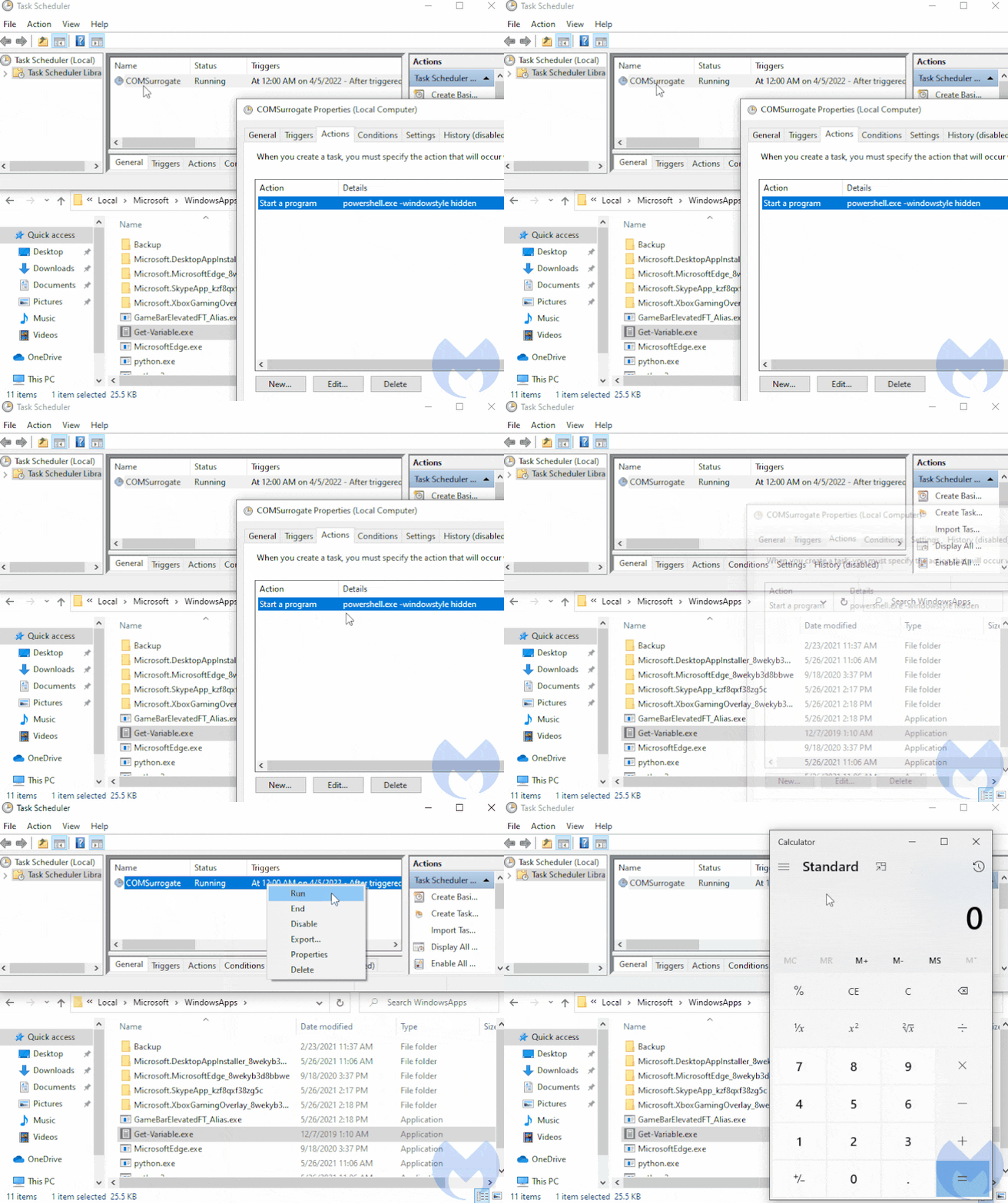
It achieves this by creating a scheduled task on systems running
Windows 10 and above, with the loader executing a command to launch
PowerShell[6]
with a hidden
window[7] (i.e., -WindowStyle
Hidden) to conceal the malicious
activity[8] from being detected.
“It so happens that Get-Variable[9]
is a valid PowerShell cmdlet[10] (a cmdlet is a
lightweight command used in the Windows PowerShell environment)
which is used to retrieve the value of a variable in the current
console,” the researchers explained.
But given the fact that PowerShell is executed by default in the
WindowsApps path[11], the command issued
during the scheduled task creation results in the execution of the
malicious binary in the place of its legitimate counterpart.
This effectively means that “an adversary can easily achieve
persistence [by] combining a scheduled task and any payload (as
long as it is called Get-Variable.exe and placed in the proper
location),” the researchers said.
The latest findings come as cybersecurity company Trustwave last
month detailed[12] an email-based phishing
campaign that leverages Microsoft Compiled HTML Help (CHM) files to
distribute the Vidar malware in an effort to fly under the
radar.
References
- ^
said
(blog.malwarebytes.com) - ^
FR3D.HK
(fr3d.hk) - ^
noted
(cloudsek.com) - ^
remote template injection
(attack.mitre.org) - ^
Get-Variable.exe
(www.virustotal.com) - ^
PowerShell
(docs.microsoft.com) - ^
hidden window
(devblogs.microsoft.com) - ^
conceal the malicious activity
(attack.mitre.org) - ^
Get-Variable
(docs.microsoft.com) - ^
cmdlet
(docs.microsoft.com) - ^
WindowsApps path
(docs.microsoft.com) - ^
detailed
(www.trustwave.com)
Read more https://thehackernews.com/2022/04/researchers-uncover-how-colibri-malware.html