The U.S. Treasury Department on Tuesday sanctioned Hydra, the
same day German law enforcement authorities disrupted[1]
the world’s largest and longest-running dark web marketplace
following a coordinated operation in partnership with U.S.
officials.
The sanctions are part of an “international effort to disrupt
proliferation of malicious cybercrime services, dangerous drugs,
and other illegal offerings available through the Russia-based
site,” the Treasury Department said[2]
in a statement.
Along with the sanctions, the Office of Foreign Assets Control
(OFAC) disclosed a list of more than 100 virtual currency
addresses[3] that have been
identified as associated with the entity’s operations to conduct
illicit transactions.
The sanctions come as Germany’s Federal Criminal Police Office
shut down the online criminal marketplace that it said specialized
in narcotics trade, seizing its servers and 543 bitcoins worth 23
million euros ($25.3 million).
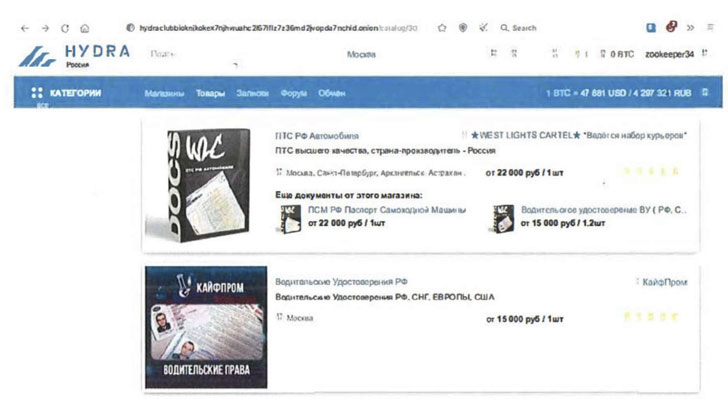
Hydra was a Russian-language darknet platform[4]
that had been accessible via the Tor network since at least
November 2015, facilitating the trafficking of outlawed goods and
services, including illegal drugs, stolen financial information,
fraudulent identification documents, and money laundering and
mixing services.
The Treasury Department, in a related move, also sanctioned the
virtual currency exchange Garantex, making it the third crypto
platform to be blocklisted by the U.S. after SUEX[5]
and CHATEX[6].
“Analysis of known Garantex transactions shows that over $100
million in transactions are associated with illicit actors and
darknet markets, including nearly $6 million from Russian RaaS gang
Conti and also including approximately $2.6 million from Hydra,”
the Treasury Department noted.
In a simultaneous move, the Department of Justice (DoJ) announced[7]
charges against Dmitry Olegovich Pavlov, a 30-year-old Russian
national, in connection with operating the servers used to run
Hydra, in addition to accusing him for furthering the distribution
of narcotics and engaging in money laundering.
Pavlov is alleged to have operated a company named Promservice
Ltd., also known as Hosting Company Full Drive, All Wheel Drive,
and 4x4host.ru, to commandeer the servers. He also purportedly
conspired with other operators of the marketplace by providing the
infrastructure backbone that enabled its success in a “competitive
darknet market environment.”
“In 2021, Hydra accounted for an estimated 80% of all darknet
market-related cryptocurrency transactions, and since 2015, the
marketplace has received approximately $5.2 billion in
cryptocurrency,” the DoJ said.
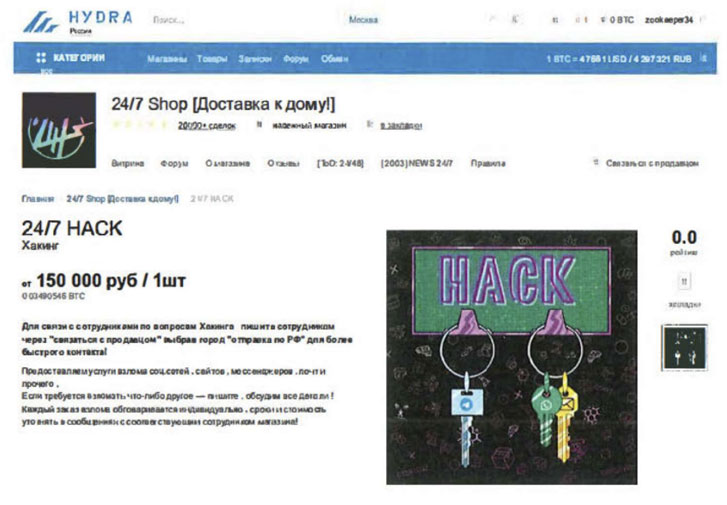
Besides allowing vendors to openly advertise a variety of deadly
drugs for sale through a five-star rating system, Hydra is also
said to have functioned as a distribution channel for forged
passports and drivers’ licenses as well as hacking tools and
services that allowed bad actors to gain illegal access to online
accounts.
These transactions on Hydra were conducted in virtual currency
and its administrators charged a commission for every transaction
conducted on the website. Hydra also provided users with cash-out
and mixing services to convert their bitcoins into different forms
of digital crypto assets and conceal their tracks.
“The dismantling of the Hydra Market, the dark web’s largest
supplier of illicit goods and services, sends a message to these
electronic criminal kingpins that think they can operate with
impunity,” said Special Agent in Charge Anthony Salisbury of
Homeland Security Investigations (HSI) Miami.
“HSI will continue to work with our U.S. and international law
enforcement partners to target these transnational criminal
organizations who attempt to manipulate the anonymity of the dark
web to push their poison all over the world,” Salisbury added.
The takedown has predictably “prompted heated discussions” on
the dark web, as threat actors relying on the services offered by
Hydra speculate about the future of the marketplace and point out
the possibility that authorities or other malicious parties could
“set up fake versions of Hydra in order to track down former
users.”
However, the administrators of Hydra have not acknowledged the
closure and are attempting to paint a different picture,
cybersecurity company Flashpoint said[8], with the operators
reportedly claiming that “the market is undergoing ‘technical
works.'”
References
Read more https://thehackernews.com/2022/04/us-treasury-department-sanctions-russia.html