
The notorious cybercrime group known as FIN7 has diversified its
initial access vectors to incorporate software supply chain
compromise and the use of stolen credentials, new research has
revealed.
“Data theft extortion or ransomware deployment following
FIN7-attributed activity at multiple organizations, as well as
technical overlaps, suggests that FIN7 actors have been associated
with various ransomware operations over time,” incident response
firm Mandiant said[1]
in a Monday analysis.
The cybercriminal group, since its emergence in the mid-2010s,
has gained notoriety for large-scale malware campaigns targeting
the point-of-sale (POS) systems aimed at restaurant, gambling, and
hospitality industries with credit card-stealing malware.
FIN7’s shift in monetization strategy towards ransomware follows
an October 2021 report from Recorded Future’s Gemini Advisory unit,
which found[2]
the adversary setting up a fake front company named Bastion Secure
to recruit unwitting penetration testers in a lead up to a
ransomware attack.
Then earlier this January, the U.S. Federal Bureau of
Investigation (FBI) issued[3]
a Flash Alert warning organizations that the financially motivated
gang was sending malicious USB drives (aka BadUSB[4]) to U.S. business
targets in the transportation, insurance, and defense industries to
infect systems with malware, including ransomware.
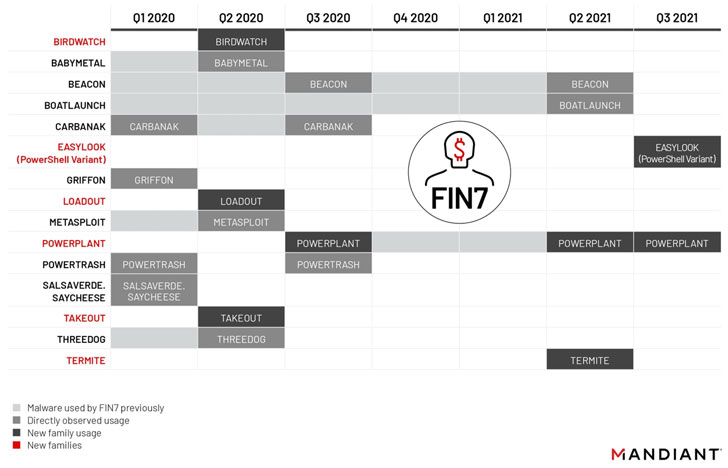
Recent intrusions staged by the actor since 2020 have involved
the deployment of a vast PowerShell backdoor framework called
POWERPLANT, continuing the group’s penchant for using
PowerShell-based malware for its offensive operations.
“There is no doubt about it, PowerShell is FIN7’s love
language,” Mandiant researchers said.
In one of the attacks, FIN7 was observed compromising a website
that sells digital products in order to tweak multiple download
links to make them point to an Amazon S3 bucket hosting trojanized
versions that contained Atera Agent, a legitimate remote management
tool, which then delivered POWERPLANT to the victim’s system.
The supply chain attack also marks the group’s evolving
tradecraft for initial access and the deployment of first-stage
malware payloads, which have typically centered around phishing
schemes.
Other tools used by the group to facilitate its infiltrations
include EASYLOOK, a reconnaissance utility; BOATLAUNCH, a helper
module designed to bypass Windows AntiMalware Scan Interface
(AMSI); and BIRDWATCH, a .NET-based downloader employed to fetch
and execute next-stage binaries received over HTTP.
“Despite indictments of members of FIN7 in 2018 and a related[5]
sentencing[6]
in 2021 announced by the U.S. Department of Justice, at least some
members of FIN7 have remained active and continue to evolve their
criminal operations over time,” Mandiant researchers said.
“Throughout their evolution, FIN7 has increased the speed of
their operational tempo, the scope of their targeting, and even
possibly their relationships with other ransomware operations in
the cybercriminal underground.”
References
Read more https://thehackernews.com/2022/04/fin7-hackers-leveraging-password-reuse.html