
A previously undocumented “sophisticated” information-stealing
malware named BlackGuard is being advertised for sale on Russian
underground forums for a monthly subscription of $200.
“BlackGuard has the capability to steal all types of information
related to Crypto wallets, VPN, Messengers, FTP credentials, saved
browser credentials, and email clients,” Zscaler ThreatLabz
researchers Mitesh Wani and Kaivalya Khursale said[1]
in a report published last week.
Also sold for a lifetime price of $700, BlackGuard is designed
as a .NET-based malware that’s actively under development, boasting
of a number of anti-analysis, anti-debugging, and anti-evasion
features that allows it to kill processes related to antivirus
engines and bypass string-based detection.
What’s more, it checks the IP address of the infected devices by
sending a request to the domain “https://ipwhois[.]app/xml/,” and
exit itself if the country is one among the Commonwealth of
Independent States (CIS).
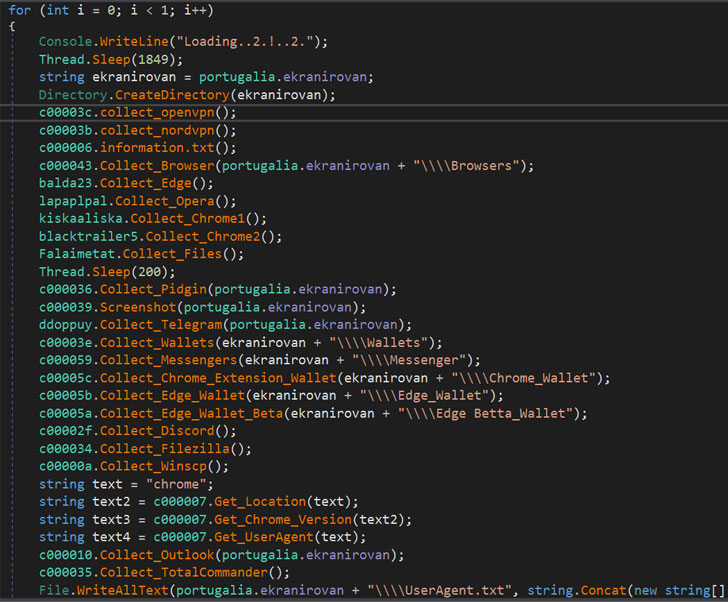
BlackGuard’s extensive functionality means it can amass
information stored in browsers, such as passwords, cookies,
autofill data, browsing history, 17 different cold cryptocurrency
wallets, and as many as six messaging apps, including Telegram,
Signal, Tox, Element, Pidgin, and Discord.
In addition, the malware targets 21 crypto wallet extensions
installed in Chrome and Edge browsers, and three VPN apps NordVPN,
OpenVPN, and ProtonVPN, the results of which are subsequently
compressed into a ZIP archive and exfiltrated to a remote
server.
The findings come as Morphisec disclosed details of another
infostealer family called Mars[2]
that’s been observed leveraging fraudulent Google Ads for
well-known software like OpenOffice to distribute the malware.
“While applications of BlackGuard are not as broad as other
stealers, BlackGuard is a growing threat as it continues to be
improved and is developing a strong reputation in the underground
community,” the researchers said.
Read more https://thehackernews.com/2022/04/experts-shed-light-on-blackguard.html