A nascent information stealer called Mars has been observed in
campaigns that take advantage of cracked versions of the malware to
steal information stored in web browsers and cryptocurrency
wallets.
“Mars Stealer is being distributed via social engineering
techniques, malspam campaigns, malicious software cracks, and
keygens,” Morphisec malware researcher Arnold Osipov said[1]
in a report published Tuesday.
Based on the Oski Stealer[2]
and first discovered in June 2021, Mars
Stealer[3] is said to be constantly
under development and available for sale on over 47 underground
forums, darknet sites, and Telegram channels, costing only $160 for
a lifetime subscription.
Information stealers allow adversaries to vacuum personal
information from compromised systems, including stored credentials
and browser cookies, which are then sold on criminal marketplaces
or used as a springboard for launching further attacks.
The release of Mars Stealer last year has also been accompanied
by a steady increase in attack campaigns, some of which have
involved the use of a cracked version of the malware that has been
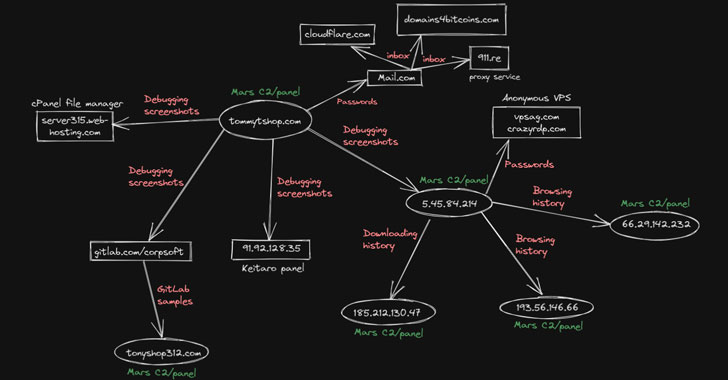
configured in such a manner that it has exposed critical assets on
the internet, inadvertently leaking details about the threat
actor’s infrastructure.
Also notable is a campaign observed last month that siphoned the
passwords belonging to students, faculty members, and content
makers who have downloaded trojanized versions of legitimate
applications.
On top of that, the cybersecurity company noted that it
“identified credentials which led to the full compromise of a
leading healthcare infrastructure provider in Canada, and a number
of high-profile Canadian service companies.”
While Mars Stealer is most commonly distributed via spam email
messaging containing a compressed executable, download link, or
document payload, it’s also propagated via fraudulent cloned
websites advertising well-known software such as OpenOffice that
were then pushed through Google Ads.
The goal is to leverage geographically targeted ads to trick
potential victims searching for the original software into visiting
a malicious site instead, ultimately leading to the deployment of
the malware.
Mars Stealer, for its part, is engineered to harvest and
exfiltrate browser autofill data, credit card information, browser
extension details, including that of cryptocurrency wallets like
Metamask, Coinbase Wallet, and Binance Wallet, and system
metadata.
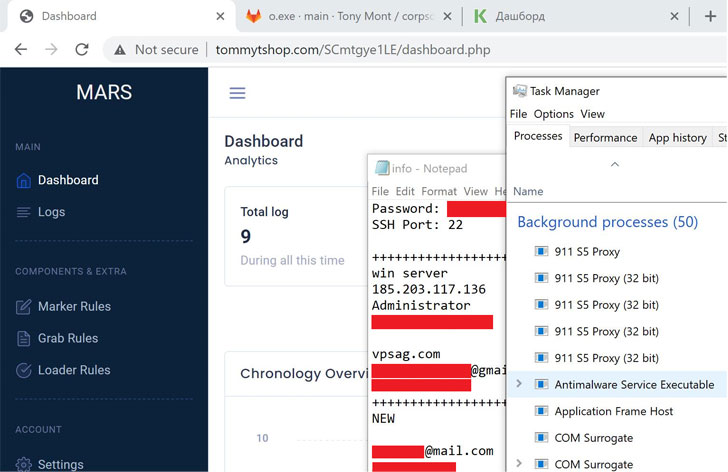
But because the threat actor compromised their own machine with
the Mars Stealer during debugging, the OPSEC mistake allowed the
researchers to attribute the campaign to a Russian speaker as well
as uncover details about the adversary’s use of GitLab and stolen
credentials to place Google Ads.
“Infostealers offer an accessible entry point to criminal
activity,” Osipov said, adding such tools “empower novice
cybercriminals to build a reputation they can leverage to acquire
more powerful malware from more sophisticated actors.”
References
- ^
said
(blog.morphisec.com) - ^
Oski
Stealer (www.cyberark.com) - ^
Mars
Stealer (3xp0rt.com)
Read more https://thehackernews.com/2022/03/researchers-expose-mars-stealer-malware.html