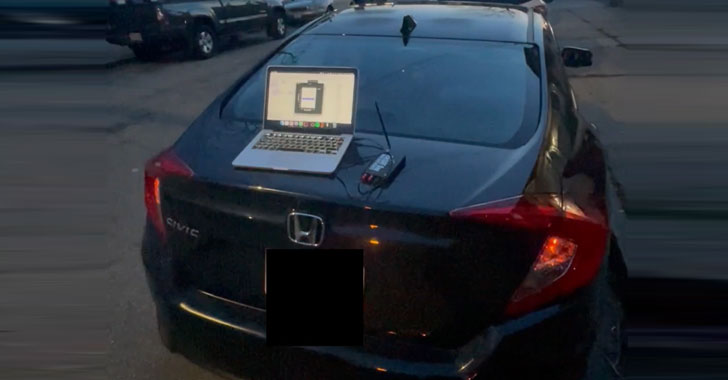
A duo of researchers has released a proof-of-concept (PoC)
demonstrating the ability for a malicious actor to remote lock,
unlock, and even start Honda and Acura vehicles by means of what’s
called a replay attack.
The attack is made possible, thanks to a vulnerability in its
remote keyless system (CVE-2022-27254[1]) that affects Honda
Civic LX, EX, EX-L, Touring, Si, and Type R models manufactured
between 2016 and 2020. Credited with discovering the issue are
Ayyappan Rajesh, a student at UMass Dartmouth, and Blake Berry
(HackingIntoYourHeart).
“A hacker can gain complete and unlimited access to locking,
unlocking, controlling the windows, opening the trunk, and starting
the engine of the target vehicle where the only way to prevent the
attack is to either never use your fob or, after being compromised
(which would be difficult to realize), resetting your fob at a
dealership,” Berry explained[2]
in a GitHub post.
The underlying issue is that the remote key fob on the affected
Honda vehicles transmits the same, unencrypted radio frequency
signal (433.215MHz) to the car, effectively enabling an adversary
to intercept and replay the request at a later time to wirelessly
start the engine as well as lock and unlock the doors.
This is not the first time a flaw of this kind has been
uncovered in Honda vehicles. A related issue discovered in 2017
Honda HR-V models (CVE-2019-20626[3], CVSS score: 6.5) is
said to have been “seemingly ignored” by the Japanese company,
Berry alleged.
“Manufacturers must implement Rolling Codes[4], otherwise known as
hopping code,” Rajesh said[5]. “It is a security
technology commonly used to provide a fresh code for each
authentication of a remote keyless entry (RKE) or passive keyless
entry (PKE) system.”
We have asked Honda for a comment, and we will update the story
once we hear back.
References
- ^
CVE-2022-27254
(nvd.nist.gov) - ^
explained
(github.com) - ^
CVE-2019-20626
(nvd.nist.gov) - ^
Rolling
Codes (en.wikipedia.org) - ^
said
(github.com)
Read more https://thehackernews.com/2022/03/hondas-keyless-access-bug-could-let.html