
Google’s Threat Analysis Group (TAG) took the wraps off a new
initial access broker[1]
that it said is closely affiliated to a Russian cyber crime gang
notorious for its Conti and Diavol ransomware operations.
Dubbed Exotic Lily, the financially motivated threat actor has
been observed exploiting a now-patched critical flaw in the
Microsoft Windows MSHTML platform (CVE-2021-40444[2]) as part of widespread
phishing campaigns that involved sending no fewer than 5,000
business proposal-themed emails a day to 650 targeted organizations
globally.
“Initial access brokers are the opportunistic locksmiths of the
security world, and it’s a full-time job,” TAG researchers Vlad
Stolyarov and Vlad Stolyarov said[3]. “These groups
specialize in breaching a target in order to open the doors — or
the Windows — to the malicious actor with the highest bid.”
Exotic Lily, first spotted in September 2021, is said to have
been involved in data exfiltration and deployment of the
human-operated Conti and Diavol[4]
ransomware strains, both of which share overlaps with the Russian
cybercriminal syndicate called Wizard Spider that’s also known for
operating TrickBot[5], BazarBackdoor[6], and Anchor[7].
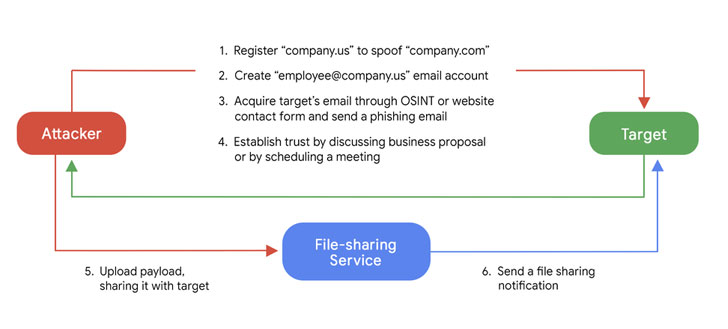
The threat actor’s social engineering lures, sent from spoofed
email accounts, have specifically singled out IT, cybersecurity,
and healthcare sectors, although post November 2021, the attacks
have grown to be more indiscriminate, targeting a wide variety of
organizations and industries.
Besides using fictitious companies and identities as a means to
build trust with the targeted entities, Exotic Lily has leveraged
legitimate file-sharing services like WeTransfer, TransferNow and
OneDrive to deliver BazarBackdoor payloads[8]
in a bid to evade detection mechanisms.
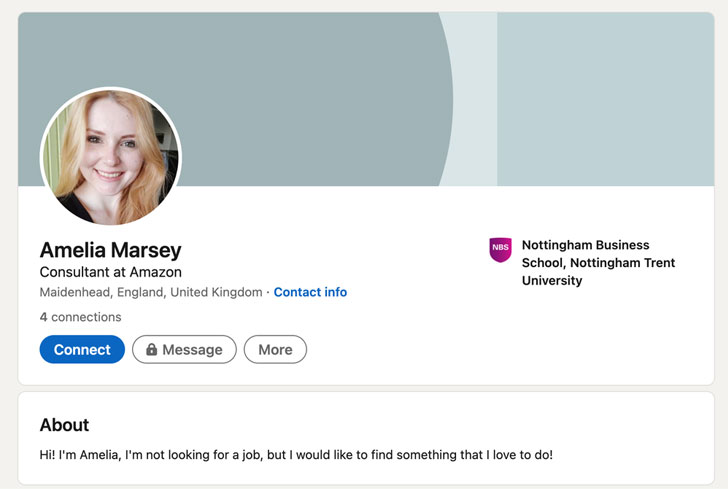
The rogue personas often posed as employees of firms such as
Amazon, complete with fraudulent social media profiles on LinkedIn
that featured fake AI-generated profile pictures. The group is also
said to have impersonated real company employees by lifting their
personal data from social media and business databases like
RocketReach and CrunchBase.
“At the final stage, the attacker would upload the payload to a
public file-sharing service (TransferNow, TransferXL, WeTransfer or
OneDrive) and then use a built-in email notification feature to
share the file with the target, allowing the final email to
originate from the email address of a legitimate file-sharing
service and not the attacker’s email, which presents additional
detection challenges,” the researchers said.
Also delivered using the MHTML exploit is a custom loader called
Bumblebee that’s orchestrated to gather and exfiltrate system
information to a remote server, which responds back commands to
execute shellcode and run next-stage executables, including Cobalt
Strike.
An analysis of the Exotic Lily’s communication activity
indicates that the threat actors have a “typical 9-to-5 job” on
weekdays and may be possibly working from a Central or an Eastern
Europe time zone.
“EXOTIC LILY seems to operate as a separate entity, focusing on
acquiring initial access through email campaigns, with follow-up
activities that include deployment of Conti and Diavol ransomware,
which are performed by a different set of actors,” the researchers
concluded.
References
- ^
initial
access broker (thehackernews.com) - ^
CVE-2021-40444
(thehackernews.com) - ^
said
(blog.google) - ^
Diavol
(thehackernews.com) - ^
TrickBot
(thehackernews.com) - ^
BazarBackdoor
(thehackernews.com) - ^
Anchor
(thehackernews.com) - ^
BazarBackdoor payloads
(abnormalsecurity.com)
Read more https://thehackernews.com/2022/03/google-uncovers-initial-access-broker.html