
In what’s yet another act of sabotage, the developer behind the
popular “node-ipc” NPM package shipped a new version to protest
Russia’s invasion of Ukraine, raising concerns about security in
the open-source and the software supply chain[1].
Affecting versions 10.1.1 and 10.1.2 of the library, the changes
introduced undesirable behavior by its maintainer RIAEvangelist,
targeting users with IP addresses located either in Russia or
Belarus, and wiping arbitrary file contents and replacing it with a
heart emoji.
Node-ipc is a prominent node
module[2] used for local and
remote inter-process communication with support for Linux, macOS,
and Windows. It has over 1.1 million weekly downloads.
“A very clear abuse and a critical supply chain security
incident will occur for any system on which this NPM package will
be called upon, if that matches a geo-location of either Russia or
Belarus,” Synk researcher Liran Tal said[3]
in an analysis.
The issue has been assigned the identifier CVE-2022-23812[4]
and is rated 9.8 out of 10 on the CVSS vulnerability scoring
system. The malicious code changes were published on March 7
(version 10.1.1), with a second update occurring 10 hours later the
same day (version 10.1.1).
Interestingly, although the destructive payload was removed from
the library with version 10.1.3, a major update was pushed after
less than four hours (version 11.0.0), which imported another
dependency called “peacenotwar[5],” also released by
RIAEvangelist as form of “non-violent protest against Russia’s
aggression.”
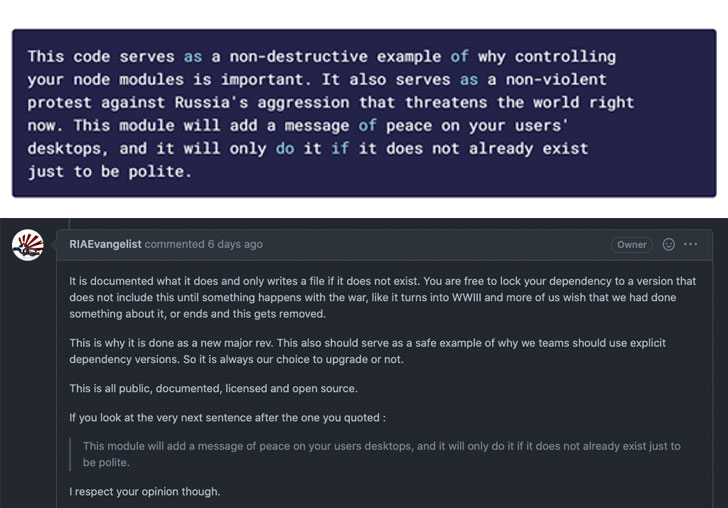
“Any time the node-ipc module functionality gets called, it
prints to STDOUT[6]
a message taken out of the peacenotwar module, as well as places a
file on the user’s Desktop directory with contents relating to the
current war-time situation of Russia and Ukraine,” Tal
explained.
As of March 15, 2022, the latest version of node-ipc – 11.1.0 –
bumps the “peacenotwar” package version from 9.1.3 to 9.1.5 and
bundles the “colors” NPM library, while also removing the STDOUT
console messages.
It’s worth noting that “colors,” along with another package
called “faker,” were both intentionally sabotaged[7]
earlier this January by its developer Marak Squires by introducing
infinite loops to the source code, effectively breaking other
applications that depended on the libraries.
According to Bleeping Computer, which first reported[8]
the corruption, the changes are said to have been retaliatory, with
the developer noting[9]
that “Respectfully, I am no longer going to support Fortune 500s
(and other smaller sized companies) with my free work.”
If anything, the idea of using popular modules as “protestware[10]” to deploy destructive
payloads and stage a supply chain compromise runs the risk of
undermining trust in open-source software.
“This security incident involves destructive acts of corrupting
files on disk by one maintainer and their attempts to hide and
restate that deliberate sabotage in different forms,” Tal said.
“While this is an attack with protest-driven motivations, it
highlights a larger issue facing the software supply chain: the
transitive dependencies in your code can have a huge impact on your
security.”
References
- ^
software
supply chain (github.com) - ^
node
module (www.npmjs.com) - ^
said
(snyk.io) - ^
CVE-2022-23812
(github.com) - ^
peacenotwar
(www.npmjs.com) - ^
STDOUT
(en.wikipedia.org) - ^
intentionally sabotaged
(snyk.io) - ^
first
reported (www.bleepingcomputer.com) - ^
noting
(web.archive.org) - ^
protestware
(github.com)
Read more https://thehackernews.com/2022/03/popular-npm-package-updated-to-wipe.html