Microsoft on Wednesday detailed a previously undiscovered
technique put to use by the TrickBot malware that involves using
compromised Internet of Things (IoT) devices as a go-between for
establishing communications with the command-and-control (C2)
servers.
“By using MikroTik routers as proxy servers for its C2 servers
and redirecting the traffic through non-standard ports, TrickBot
adds another persistence layer that helps malicious IPs evade
detection by standard security systems,” Microsoft’s Defender for
IoT Research Team and Threat Intelligence Center (MSTIC) said[1].
TrickBot, which emerged as a banking trojan in 2016, has evolved
into a sophisticated and persistent threat, with its modular
architecture enabling it to adapt its tactics to suit different
networks, environments, and devices as well as offer
access-as-a-service for next-stage payloads like Conti
ransomware.
The expansion to TrickBot’s capabilities comes amid reports of
its infrastructure going offline[2], even as the botnet has
continually refined its features to make its attack framework
durable, evade reverse engineering, and maintain the stability of
its C2 servers.

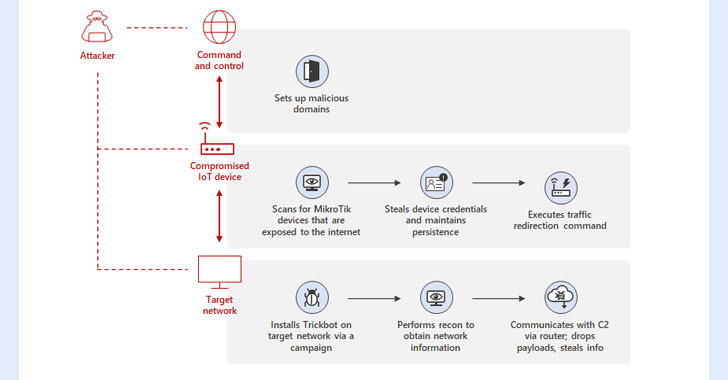
Specifically, the new method identified by MSTIC involves
leveraging hacked IoT devices such as routers from MikroTik to
“create a line of communication between the TrickBot-affected
device and the C2 server.”
This also entails breaking into the routers by using a
combination of methods, namely default passwords, brute-force
attacks, or exploiting a now-patched flaw in MikroTik RouterOS
(CVE-2018-14847[3]), followed by changing
the router’s password to maintain access.
In the next step, the attackers then issue[4]
a network address translation (NAT) command that’s designed to
redirect traffic between ports 449 and 80 in the router,
establishing a path for the TrickBot-infected hosts to communicate
with the C2 server.
“As security solutions for conventional computing devices
continue to evolve and improve, attackers will explore alternative
ways to compromise target networks,” the researchers said. “Attack
attempts against routers and other IoT devices are not new, and
being unmanaged, they can easily be the weakest links in the
network.”
References
- ^
said
(www.microsoft.com) - ^
infrastructure going offline
(thehackernews.com) - ^
CVE-2018-14847
(blog.mikrotik.com) - ^
issue
(github.com)
Read more https://thehackernews.com/2022/03/trickbot-malware-abusing-hacked-iot.html