As many as seven security vulnerabilities have been disclosed in
PTC’s Axeda software that could be weaponized to gain unauthorized
access to medical and IoT devices.
Collectively called “Access:7[1],” the weaknesses – three
of which are rated Critical in severity – potentially affect more
than 150 device models[2]
spanning over 100 different manufacturers, posing a significant
supply chain risk.
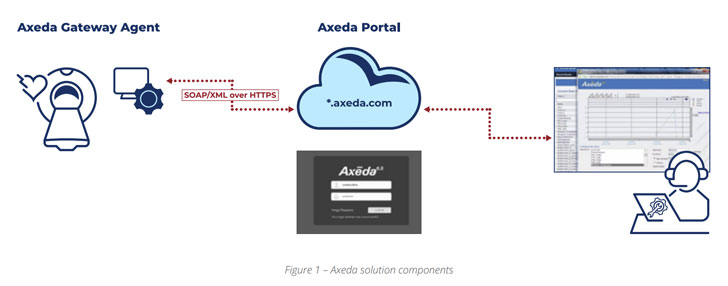
PTC’s Axeda solution includes a cloud platform that allows
device manufacturers to establish connectivity to remotely monitor,
manage and service a wide range of connected machines, sensors, and
devices via what’s called the agent, which is installed by the OEMs
before the devices are sold to customers.
“Access:7 could enable hackers to remotely execute malicious
code, access sensitive data, or alter configuration on medical and
IoT devices running PTC’s Axeda remote code and management agent,”
researchers from Forescout and CyberMDX said in a joint report
published today.
Of the 100 impacted device vendors, 55% belong to the healthcare
sector, followed by IoT (24%), IT (8%), financial services (5%),
and manufacturing (4%) industries. No less than 54% of the
customers with devices running Axeda have been identified in the
healthcare sector.
Besides medical imaging and laboratory machines, vulnerable
devices include everything from ATMs, vending machines, cash
management systems, and label printers to barcode scanning systems,
SCADA systems, asset monitoring and tracking solutions, IoT
gateways, and industrial cutters.
The list of flaws is below –
- CVE-2022-25246 (CVSS score: 9.8) – The use of
hard-coded credentials in the AxedaDesktopServer.exe service that
could enable remote takeover of a device - CVE-2022-25247 (CVSS score: 9.8) – A flaw in
ERemoteServer.exe that could be leveraged to send specially crafted
commands to obtain Remote code execution (RCE) and full file system
access - CVE-2022-25251 (CVSS score: 9.4) – Missing
authentication in the Axeda xGate.exe agent that could be used to
modify the agent’s configuration - CVE-2022-25249 (CVSS score: 7.5) – A directory
traversal flaw in the Axeda xGate.exe agent which could allow a
remote unauthenticated attacker to obtain file system read access
on the web server - CVE-2022-25250 (CVSS score: 7.5) – A
denial-of-service (DoS) flaw in the Axeda xGate.exe agent by
injecting an undocumented command - CVE-2022-25252 (CVSS score: 7.5) – A buffer
overflow vulnerability in the Axeda xBase39.dll component that
could result in a denial-of-service (DoS) - CVE-2022-25248 (CVSS score: 5.3) – An
information disclosure flaw in the ERemoteServer.exe service that
exposes the live event text log to unauthenticated parties
Successful exploitation of the flaws could equip attackers with
capabilities to remotely execute malicious code to take full
control of devices, access sensitive data, modify configurations,
and shut down specific services in the impacted devices.
The flaws, which affect all versions of the Axeda Agent prior to
6.9.3, were reported to PTC on August 10, 2021 as part of a
coordinated disclosure process[3] that involved the U.S.
Cybersecurity and Infrastructure Security Agency (CISA), Health
Information Sharing and Analysis Center (H-ISAC), and the Food and
Drug Administration (FDA).
To mitigate the flaws and prevent possible exploitation, users
are recommended to upgrade[4]
to Axeda agent version 6.9.1 build 1046, 6.9.2 build 1049, or 6.9.3
build 1051.
This is not the first time critical security vulnerabilities
primarily targeting healthcare systems have come to light. In
December 2020, CyberMDX disclosed “MDhex-Ray[5],” a severe flaw in GE
Healthcare’s CT, X-Ray, and MRI imaging products that could result
in the exposure of protected health information.
“Access:7 affects a solution sold to device manufacturers that
did not develop their in-house remote servicing system,” the
researchers said. “This makes it a supply chain vulnerability and
hence it affects many downstream manufacturers and devices.”
References
- ^
Access:7
(www.forescout.com) - ^
150
device models (www.cybermdx.com) - ^
coordinated disclosure process
(www.cisa.gov) - ^
recommended to upgrade
(www.ptc.com) - ^
MDhex-Ray
(www.cybermdx.com)
Read more https://thehackernews.com/2022/03/critical-access7-supply-chain.html