
A previously undocumented espionage tool has been deployed
against selected governments and other critical infrastructure
targets as part of a long-running espionage campaign orchestrated
by China-linked threat actors since at least 2013.
Broadcom’s Symantec Threat Hunter team characterized the
backdoor, named Daxin[1], as a technologically
advanced malware, allowing the attackers to carry out a variety of
communications and information-gathering operations aimed at
entities in the telecom, transportation, and manufacturing sectors
that are of strategic interest to China.
“Daxin malware is a highly sophisticated rootkit backdoor with
complex, stealthy command-and-control (C2) functionality that
enables remote actors to communicate with secured devices not
connected directly to the internet,” the U.S. Cybersecurity and
Infrastructure Security Agency (CISA) said[2]
in an independent advisory.
The implant takes the form of a Windows kernel driver that
implements an elaborate communications mechanism that affords the
malware a high degree of stealth and the capability to talk to
machines that are physically disconnected from the internet.
It achieves this by expressly avoiding launching its own network
services, instead opting to take advantage of legitimate TCP/IP[3]
services already running on the infected computers to blend its
communications with normal traffic on the target’s network and
receive commands from a remote peer.
“These features are reminiscent of Regin,” the researchers
noted, referring to another sophisticated malware and hacking toolkit[4] attributed to the U.S.
National Security Agency (NSA) for government spying operations
back in 2014.
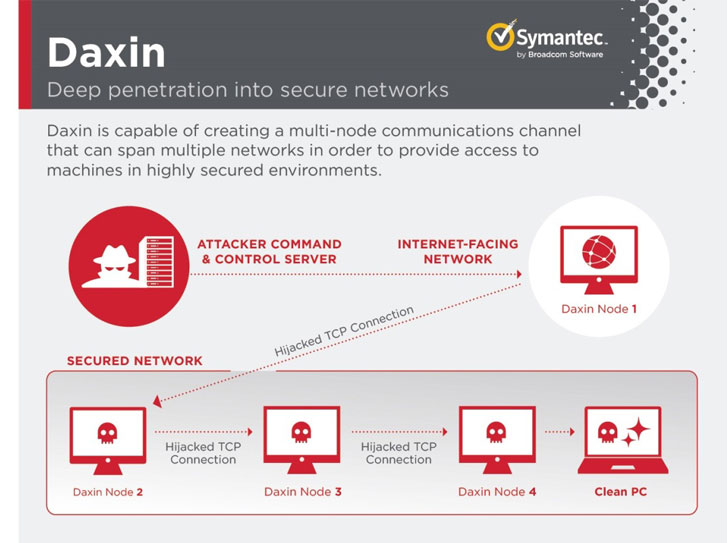
Among the unusual aspects of Daxin, besides generating no
suspicious network traffic to remain unseen, is its ability to
relay commands across a network of infected computers within the
attacked organization, creating a “multi-node communications
channel” that permits recurring access to the compromised computers
for extended periods of time.
While recent intrusions involving the backdoor are said to have
transpired in November 2021, Symantec said it uncovered code-level
commonalities with an older piece of malware called Exforel[5]
(aka Zala[6]), indicating that Daxin
may have been built by an actor with access to the latter’s
codebase or that they are the work of the same group.
The campaigns have not been attributed to a single adversary,
but a timeline of the attacks shows that Daxin was installed on
some of the same systems where tools associated with other Chinese
espionage actors like Slug were found. This includes the deployment
of both Daxin and Owprox[7]
malware on a single computer belonging to a tech company in May
2020.
“Daxin is without doubt the most advanced piece of malware […]
used by a China-linked actor,” the researchers said. “Considering
its capabilities and the nature of its deployed attacks, Daxin
appears to be optimized for use against hardened targets, allowing
the attackers to burrow deep into a target’s network and exfiltrate
data without raising suspicions.”
The disclosure arrives a week after China-based Pangu Lab outed
a “top-tier” backdoor called Bvp47[8]
put to use by the U.S. National Security Agency for over a decade
targeting as many as 287 organizations in 45 countries located
chiefly in China, Korea, Japan, Germany, Spain, India, and
Mexico.
References
Read more https://thehackernews.com/2022/03/china-linked-daxin-malware-targeted.html