
Malicious actors took advantage of a smart contract upgrade
process in the OpenSea NFT marketplace to carry out a phishing attack[1]
against 17 of its users that resulted in the theft of virtual
assets worth about $1.7 million.
NFTs[2], short for non-fungible
tokens, are digital tokens that act like certificates of
authenticity for, and in some cases represent ownership of, assets
that range from expensive illustrations to collectibles and
physical goods.
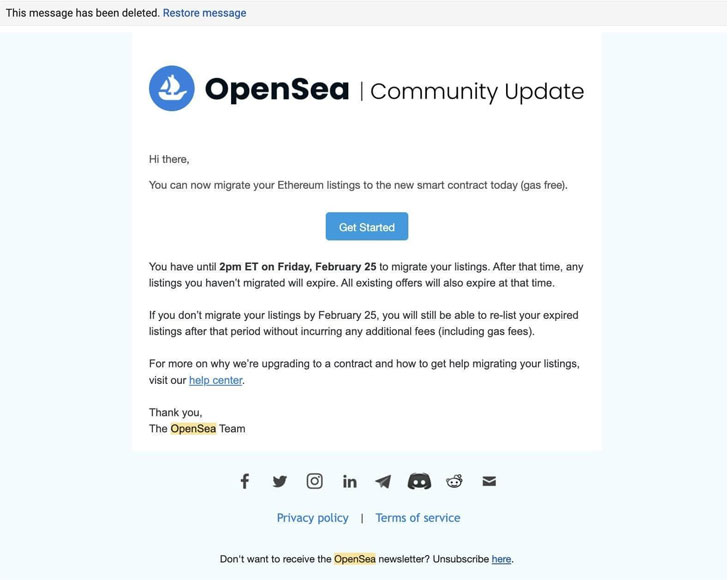
The opportunistic social engineering scam swindled the users[3]
by using the same email from OpenSea notifying users about the
upgrade, with the copycat email redirecting the victims to a
lookalike webpage, prompting them to sign a seemingly legitimate
transaction, only to steal all the NFTs in one go.
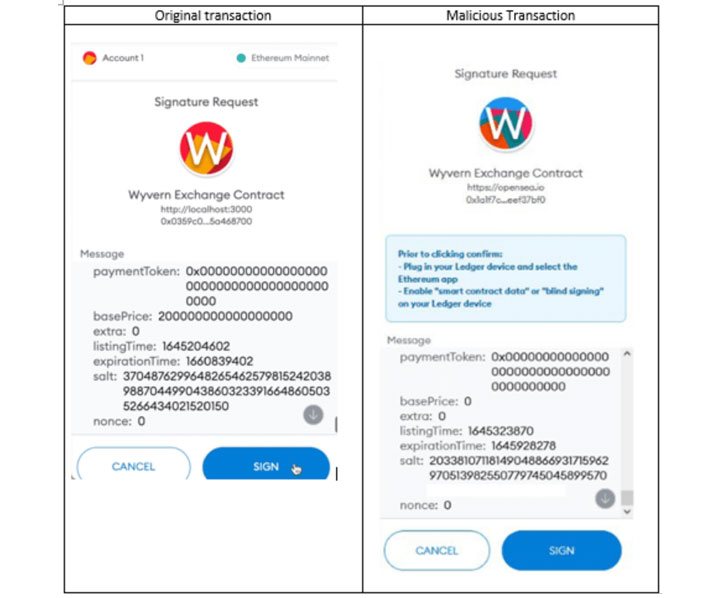
“By signing the transaction, an atomicMatch_ request would be
sent to the attacker contract,” Check Point researchers explained[4]. “From there, the
atomicMatch_ would be forwarded to the OpenSea contract,” leading
to the transfer of the NFTs from the victim to the attacker.
OpenSea’s “Wyvern[5]” smart contract
migration, which commenced on February 18 over a seven-day period
until February 25 at 2:00 PM ET, is part of the New York City-based
firm’s efforts to address old, existing inactive listings on the
Ethereum blockchain.
The company[6]
said[7]
it’s still investigating[8]
the exact source of the attack, noting that the malicious orders
had been signed by the victims before OpenSea carried out its
migration. “The attack does not appear to be active at this time.
There has been no activity on the malicious contract in >15
hours,” OpenSea said in an update.
“Signing a transaction is similar to giving someone permission
to access all your NFT’s and cryptocurrencies,” Check Point said.
“This is why signing is very dangerous. Pay extra attention to
where and when you sign a transaction.”
The development[9]
also comes as cybercriminals are exploiting the growth in
popularity of NFTs to trick victims into downloading the BitRAT remote access trojan[10] malware that’s capable
of stealing browser credentials, mining cryptocurrency, and
harvesting sensitive information.
References
- ^
phishing
attack (twitter.com) - ^
NFTs
(en.wikipedia.org) - ^
swindled
the users (etherscan.io) - ^
explained
(blog.checkpoint.com) - ^
Wyvern
(support.opensea.io) - ^
company
(twitter.com) - ^
said
(twitter.com) - ^
investigating
(twitter.com) - ^
development
(thehackernews.com) - ^
BitRAT
remote access trojan (www.fortinet.com)
Read more https://thehackernews.com/2022/02/hackers-steal-17-million-worth-of-nfts.html