“…well, of course!” is what you might think. It’s a biological
threat, so how could it affect digital assets?
But hang on. Among other effects, this pandemic has brought
about a massive shift in several technological areas. Not only did
it force numerous organizations – that up to now were reluctant –
to gear up in cyber to go digital, all at once, oftentimes with
hastily pieced together strategies.
It also made remote working (and the involved tools) grow in
double-digits, causing the good old perimeter (which was already in
a questionable state due to cloud adaption) to be basically
shattered. The office is now anywhere. And that means access to
data needs to be everywhere too.
Keeping all of this in mind, the general assumption was that in
the wake of the pandemic we would face a virtual nightmare with
vulnerable users, compromised corporate networks en masse and the
end of the (digital) world. But let’s look at some interesting
numbers of what actually happened.
Are hackers locked down too?
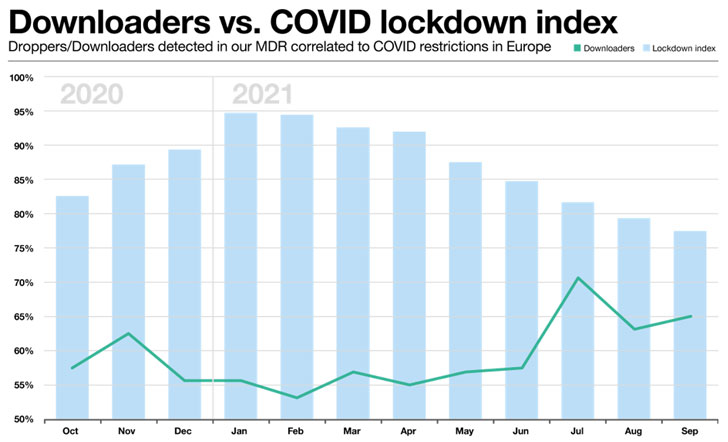
Let’s take a look at the number of droppers we observed in our
MDR data and correlate it with other data we have regarding the
intensity of COVID lockdown restrictions over time, Droppers are a
good overall indicator of malicious activity, as they often
indicate an early stage of an attack (which of course we try to
prevent in getting any further).
The COVID stringency index[1] reflected in the bar
chart comes to us from Oxford University and is a composite measure
based on nine response indicators, including school closures,
workplace closures, and travel bans, rescaled to a value from 0 to
100. In other words, the closer the bar is to 100, the more severe
the restrictions at that time. We’ve averaged the indices for the
Nordics, Benelux, Germany, France, the UK and South Africa, which
represent the bulk of our operational area.
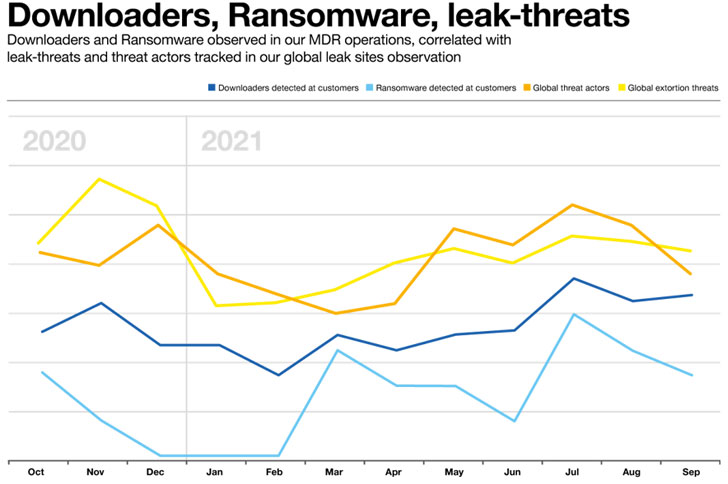
It’s also interesting to correlate the data we have from our
Threat Detection services, with data we have from observing cyber
extortion’ leak sites’ (which we have already written about
earlier).
Several observations emerge from an examination of the charts
above:
We observe a distinctive decrease in confirmed downloader
activity in the months of November and December 2020 after the
Trickbot botnet was taken down by law enforcement, and in January
and February 2021, directly after Emotet was taken down. After
those two events, downloader activity increases steadily until
peaking over the European vacation period in July.
There does appear to be a loose correlation between downloaders
– which represent the start of the cyber kill chain – and confirmed
ransomware activity – which represents the last phase of the kill
chain, which is what one would expect.
Downloader and Ransomware activities both appear to increase
over major holiday periods – Easter and mid-summer. We don’t see
such a spike over Christmas 2020, but that might be because of the
disruptive impact of the Trickbot and Emotet takedowns we alluded
to earlier.
In general, there appears to be an inverse correlation between
the stringency of COVID lockdowns and the volumes of downloader
activity. The more stringent the lockdowns, the less of this
activity we see. This general observation appears to hold for other
forms of malware activity also. As we had already observed in
earlier research, this runs contrary to the prevailing narrative
that attacks increase when users are working from home.
It takes two to make a compromise
The conclusion here appears to be, therefore, that the volume
trends and patterns in malware activity are overwhelmingly
influenced by the patterns and behaviors of the potential victims,
not the choices of the attacker. The exception may be vacation
periods, where it appears that attackers may step their activity
up.
Law enforcement activity has a notable impact, but this appears
to be short-lived because new actors and new tools tend to pop up
after another one is taken down or some of its members
arrested.
So, the final diagnosis? We can confirm that actually COVID has
not spread to digital. At least not in the fatal way that was
predicted. And that is finally some good news.
This is just another excerpt of the analysis. More details like
the incident- and malware distribution across industries or
business sizes (as well as a ton of other interesting research
topics) can be found in the Security Navigator[1]. It’s available for
download on the Orange Cyberdefense website, so have a look. It’s
worth it!
Note — This article was written and contributed by
Diana Selck-Paulsson, Lead Security Researcher at Orange
Cyberdefense.
References
- ^
Security
Navigator (orangecyberdefense.com)
Read more https://thehackernews.com/2022/02/covid-does-not-spread-to-computers.html