
A peer-to-peer Golang botnet has resurfaced after more than a
year to compromise servers belonging to entities in the healthcare,
education, and government sectors within a span of a month,
infecting a total of 1,500 hosts.
Dubbed FritzFrog, “the decentralized botnet targets any
device that exposes an SSH server — cloud instances, data center
servers, routers, etc. — and is capable of running any malicious
payload on infected nodes,” Akamai researchers said in a report[1]
shared with The Hacker News.
The new wave of attacks commenced in early December 2021, only
to pick up pace and register a 10x growth in its infection rate in
a month’s time, while peaking at 500 incidents per day in January
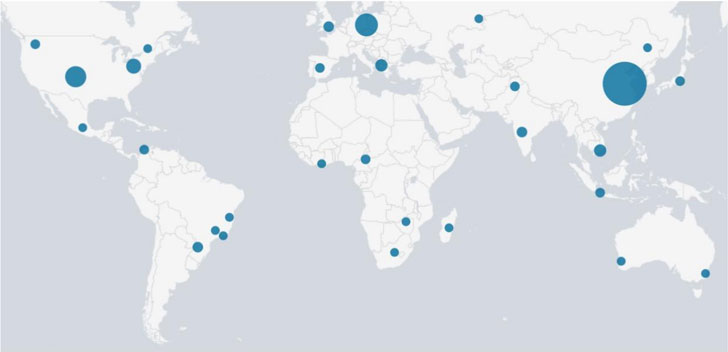
2022. The cybersecurity firm said it detected infected machines in
a European television channel network, a Russian manufacturer of
healthcare equipment, and multiple universities in East Asia.
FritzFrog was first documented[2]
by Guardicore in August 2020, elaborating the botnet’s proficiency
to strike and infect more than 500 servers spanning across Europe
and the U.S. since January that year. A large concentration of the
new infections, on the other hand, are located in China.
“Fritzfrog relies on the ability to share files over the
network, both to infect new machines and run malicious payloads,
such as the Monero crypto miner,” security researcher Ophir Harpaz
observed in 2020.
The botnet’s peer-to-peer (P2P) architecture makes it resilient
in that every compromised machine in the distributed network can
act as a command-and-control (C2) server as opposed to a single,
centralized host. What’s more, the reappearance of the botnet has
been accompanied by new additions to its functionality, including
the usage of a proxy network and the targeting of WordPress
servers.
The infection chain propagates over SSH to drop a malware
payload that then executes instructions received from the C2 server
to run additional malware binaries as well as gather system
information and files, before exfiltrating them back to the
server.
FritzFrog is notable for the fact that the P2P protocol used is
completely proprietary. While earlier versions of the malware
process masqueraded as “ifconfig” and “nginx,” the recent variants
attempt to conceal their activities under the names “apache2” and
“php-fpm.”
Other new traits incorporated into the malware include the use
of secure copy protocol (SCP[3]) to copy itself to the
remote server, a Tor proxy chaining to mask outgoing SSH
connections, an infrastructure to track WordPress servers for
follow-on attacks, and a blocklist mechanism to avoid infecting
low-end systems such as Raspberry Pi devices.
“One IP in the blocklist is from Russia. It has multiple open
ports and a long list of unpatched vulnerabilities, so it may be a
honeypot,” the researchers said. “Additionally, a second entry
points to an open-source botnet sinkhole. These two entries suggest
that the operators are attempting to evade detection and
analysis.”
The inclusion of the SCP feature may also have given the first
clue as to the malware’s origins. Akamai pointed out that the
library, written in Go, has been shared on
GitHub[4] by a user located in the
Chinese city of Shanghai.
A second piece of information linking the malware to China stems
from the fact that one of the new wallet addresses employed for
crypto mining was also used as part of the Mozi botnet campaign[5], whose operators were
arrested in China last September.
“These points of evidence, while not damning, lead us to believe
a possible link exists to an actor operating in China, or an actor
masquerading as Chinese,” the researchers concluded.
References
- ^
report
(www.akamai.com) - ^
first
documented (thehackernews.com) - ^
SCP
(en.wikipedia.org) - ^
shared on GitHub
(github.com) - ^
Mozi
botnet campaign (thehackernews.com)
Read more https://thehackernews.com/2022/02/fritzfrog-p2p-botnet-attacking.html