
The Russia-linked threat actor known as APT29 targeted European
diplomatic missions and Ministries of Foreign Affairs as part of a
series of spear-phishing campaigns mounted in October and November
2021.
According to ESET’s T3 2021 Threat Report[1]
shared with The Hacker News, the intrusions paved the way for the
deployment of Cobalt Strike Beacon on compromised systems, followed
by leveraging the foothold to drop additional malware for gathering
information about the hosts and other machines in the same
network.
Also tracked under the names The Dukes, Cozy Bear, and Nobelium,
the advanced persistent threat group is an infamous cyber-espionage
group that has been active for more than a decade, with its attacks
targeting Europe and the U.S., before it gained widespread
attention for the supply‐chain compromise[2]
of SolarWinds, leading to further infections in several downstream
entities, including U.S. government agencies in 2020.
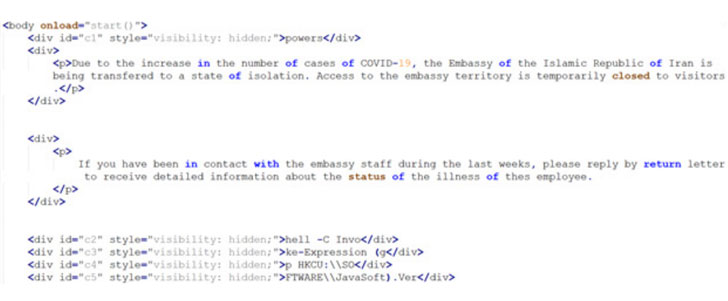
The spear-phishing attacks commenced with a COVID-19-themed
phishing email impersonating the Iranian Ministry of Foreign
Affairs and containing an HTML attachment that, when opened,
prompts the recipients to open or save what appears to be an ISO
disk image file (“Covid.iso”).
Should the victim opt to open or download the file,” a small
piece of JavaScript decodes the ISO file, which is embedded
directly in the HTML attachment.” The disk image file, in turn,
includes an HTML application that’s executed using mshta.exe[3]
to run a piece of PowerShell code that ultimately loads the Cobalt
Strike Beacon onto the infected system.
ESET also characterized APT29’s reliance on HTML and ISO disk
images (or VHDX files) as an evasion technique orchestrated
specifically to evade Mark of the Web (MOTW[4]) protections, a security
feature introduced by Microsoft to determine the origin of a
file.
“An ISO disk image doesn’t propagate the so-called Mark of the
Web to the files inside the disk image,” the researchers said. “As
such, and even if the ISO were downloaded from the internet, no
warning would be dis- played to the victim when the HTA is
opened.”
Upon successfully gaining initial access, the threat actor
delivered a variety of off-the-shelf tools to query the target’s
Active Directory (AdFind[5]), execute commands on a
remote machine using SMB protocol (Sharp-SMBExec[6]), carry out
reconnaissance (SharpView[7]), and even an exploit
for a Windows privilege escalation flaw (CVE-2021-36934[8]) to carry out follow-on
attacks.
“Recent months have shown that The Dukes are a serious threat to
western organizations, especially in the diplomatic sector,” the
researchers noted. “They are very persistent, have good operational
security, and they know how to create convincing phishing
messages.”
References
- ^
T3 2021
Threat Report (www.welivesecurity.com) - ^
supply‐chain compromise
(thehackernews.com) - ^
mshta.exe
(www.mcafee.com) - ^
MOTW
(docs.microsoft.com) - ^
AdFind
(www.joeware.net) - ^
Sharp-SMBExec
(github.com) - ^
SharpView
(github.com) - ^
CVE-2021-36934
(msrc.microsoft.com)
Read more https://thehackernews.com/2022/02/russian-apt-hackers-used-covid-19-lures.html