
Systems hosting content pertaining to the National Games of
China were successfully breached last year by an unnamed
Chinese-language-speaking hacking group.
Cybersecurity firm Avast, which dissected[1]
the intrusion, said that the attackers gained access to a web
server 12 days prior to the start of the event on September 3 to
drop multiple reverse web shells for remote access and achieve
permanent foothold in the network.
The National Games of China[2], a multi-sport event
held every four years, took place in the Shaanxi Province between
September 15 and 27, 2021.
The Czech company said it was unable to determine the nature of
the information stolen by the hackers, adding it has “reason to
believe [the attackers] are either native Chinese-language speakers
or show high fluency in Chinese.” The breach is said to have been
resolved ahead of the start of the games.
The initial access was facilitated by exploiting a vulnerability
in the webserver. But before dropping the web shells, the adversary
also experimented with the type of files that they were able to
upload to the server, only to follow it up with submitting
executable code that masqueraded as seemingly harmless images
files.
Additionally, attempts were made to reconfigure the server to
execute the Behinder web shell[3], failing which the
operators “uploaded and ran an entire Tomcat server properly
configured and weaponized” with the post-exploitation tool.
“After gaining access, the attackers tried to move through the
network using exploits and bruteforcing services in an automated
way,” Avast researchers David Álvarez Pérez and Jan Neduchal
said.
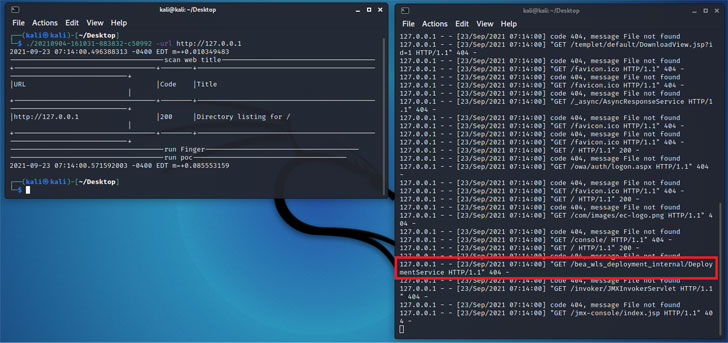
Among other tools uploaded to the server included a network
scanner and a custom one-click exploitation framework written in Go
that enabled the threat actor to carry out lateral movement and
autonomously break into other devices within the same network.
“Go is a programming language becoming more and more popular
which can be compiled for multiple operating systems and
architectures, in a single binary self-containing all
dependencies,” the researchers said, calling out the increasing use
of Go-based malware[4]
to conduct cyber attacks.
“So we expect to see malware and grey tools written in this
language in future attacks, especially in [Internet of things]
attacks where a broad variety of devices leveraging different kinds
of processor architectures are involved.”
References
- ^
dissected
(decoded.avast.io) - ^
National
Games of China (en.wikipedia.org) - ^
Behinder
web shell (github.com) - ^
Go-based
malware (www.intezer.com)
Read more https://thehackernews.com/2022/02/hackers-backdoored-systems-at-chinas.html