Microsoft on Friday shared more of the tactics, techniques, and
procedures (TTPs) adopted by the Russia-based Gamaredon hacking
group to facilitate a barrage of cyber espionage attacks aimed at
several entities in Ukraine over the past six months.
The attacks are said to have singled out government, military,
non-government organizations (NGO), judiciary, law enforcement, and
non-profit organizations with the main goal of exfiltrating
sensitive information, maintaining access, and leveraging it to
move laterally into related organizations.
The Windows maker’s Threat Intelligence Center (MSTIC) is
tracking the cluster under the moniker ACTINIUM (previously as
DEV-0157), sticking to its tradition of identifying nation-state
activities by chemical element names.
The Ukrainian government, in November 2021, publicly attributed[1]
Gamaredon to the Russian Federal Security Service (FSB) and
connected its operations to the FSB Office of Russia in the
Republic of Crimea and the city of Sevastopol.
“Since October 2021, ACTINIUM has targeted or compromised
accounts at organizations critical to emergency response and
ensuring the security of Ukrainian territory, as well as
organizations that would be involved in coordinating the
distribution of international and humanitarian aid to Ukraine in a
crisis,” MSTIC researchers said[2].
It’s worth pointing out that the Gamaredon threat group
represents a unique set of attacks divorced from last month’s
cyber offensives[3]
that knocked out multiple Ukraine government
agencies[4] and corporate entities
with destructive data-wiping malware[5] disguised as
ransomware.
The attacks primarily leverage spear-phishing emails as an
initial access vector, with the messages carrying malware-laced
macro attachments that employ remote templates containing malicious
code when the recipients open the rigged documents.
In an interesting tactic, the operators also embed a tracking
pixel-like “web bug” within the body of the phishing message to
monitor if a message has been opened, following which, the
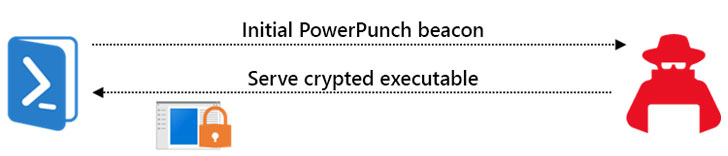
infection chain triggers a multi-stage process that culminates in
the deployment of several binaries, including —
- PowerPunch – A PowerShell-based dropper and
downloader used to retrieve the next-stage executables
remotely - Pterodo – A constantly evolving feature-rich
backdoor that also sports a range of capabilities intended to make
analysis more difficult, and - QuietSieve – A heavily-obfuscated .NET binary
specifically geared towards data exfiltration and reconnaissance on
the target host
“While the QuietSieve malware family is primarily geared towards
the exfiltration of data from the compromised host, it can also
receive and execute a remote payload from the operator,” the
researchers explained, while also calling out its ability to take
screenshots of the compromised host about every five minutes.
This is far from the only intrusion staged[6]
by the threat actor, which also struck an unnamed Western government
organization[7] in Ukraine last month
via a malware-laced resume for an active job listing with the
entity posted on a local job portal. It also targeted the country’s
State Migration Service (SMS) in December 2021.
The findings also arrive as Cisco Talos, in its continuing
analysis of the January incidents, disclosed details of an ongoing
disinformation campaign[8]
attempting to attribute the defacement and wiper attacks to
Ukrainian groups that date back at least nine months.
References
- ^
publicly
attributed (thehackernews.com) - ^
said
(www.microsoft.com) - ^
cyber
offensives (thehackernews.com) - ^
multiple
Ukraine government agencies
(thehackernews.com) - ^
destructive data-wiping malware
(thehackernews.com) - ^
intrusion staged
(thehackernews.com) - ^
unnamed
Western government organization
(thehackernews.com) - ^
disinformation campaign
(blog.talosintelligence.com)
Read more https://thehackernews.com/2022/02/microsoft-uncovers-new-details-of.html