
Microsoft has disclosed details of a large-scale, multi-phase
phishing campaign that uses stolen credentials to register devices
on a victim’s network to further propagate spam emails and widen
the infection pool.
The tech giant said the attacks manifested through accounts that
were not secured using multi-factor authentication (MFA), thereby
making it possible for the adversary to take advantage of the
target’s bring-your-own-device (BYOD) policy and introduce their
own rogue devices using the pilfered credentials.
The attacks took place in two stages. “The first campaign phase
involved stealing credentials in target organizations located
predominantly in Australia, Singapore, Indonesia, and Thailand,”
Microsoft 365 Defender Threat Intelligence Team said[1]
in a technical report published this week.
“Stolen credentials were then leveraged in the second phase, in
which attackers used compromised accounts to expand their foothold
within the organization via lateral phishing as well as beyond the
network via outbound spam.”
The campaign started with users receiving a DocuSign-branded
phishing lure containing a link, which, upon clicking, redirected
the recipient to a rogue website masquerading as the login page for
Office 365 to steal the credentials.
The credential theft not only resulted in the compromise of over
100 mailboxes across different companies, but also enabled the
attackers to implement an inbox rule to thwart detection. This was
then followed by a second attack wave that abused the lack of MFA
protections to enroll an unmanaged Windows device to the company’s
Azure Active Directory (AD) instance and spread the
malicious messages.
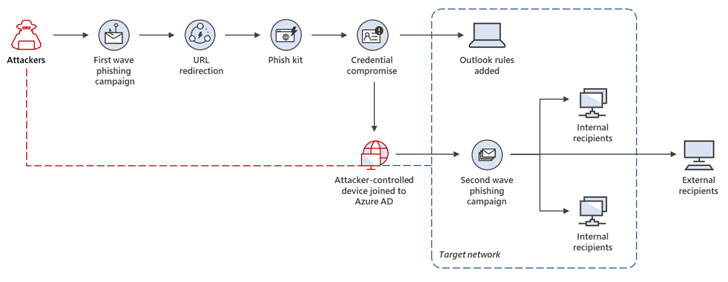
By connecting the attacker-controlled device to the network, the
novel technique made it viable to expand the attackers’ foothold,
covertly proliferate the attack, and move laterally throughout the
targeted network.
“To launch the second wave, the attackers leveraged the targeted
user’s compromised mailbox to send malicious messages to over 8,500
users, both in and outside of the victim organization,” Microsoft
said. “The emails used a SharePoint sharing invitation lure as the
message body in an attempt to convince recipients that the
‘Payment.pdf’ file being shared was legitimate.”
The development comes as email-based social engineering attacks
continue to be the most dominant means for attacking enterprises to
gain initial entry and drop malware on compromised systems.
Earlier this month, Netskope Threat Labs disclosed[2]
a malicious campaign attributed to the OceanLotus[3]
group that bypassed signature-based detections by using
non-standard file types such as web archive file (.MHT) attachments
to deploy information-stealing malware.
In addition to turning on MFA, implementing best practices such
as good credential hygiene and network segmentation can “increase
the ‘cost’ to attackers trying to propagate through the
network.”
“These best practices can limit an attacker’s ability to move
laterally and compromise assets after initial intrusion and should
be complemented with advanced security solutions that provide
visibility across domains and coordinate threat data across
protection components,” Microsoft added.
References
Read more https://thehackernews.com/2022/01/hackers-using-device-registration-trick.html