Google on Tuesday announced that it is abandoning its
controversial plans for replacing third-party cookies in favor of a
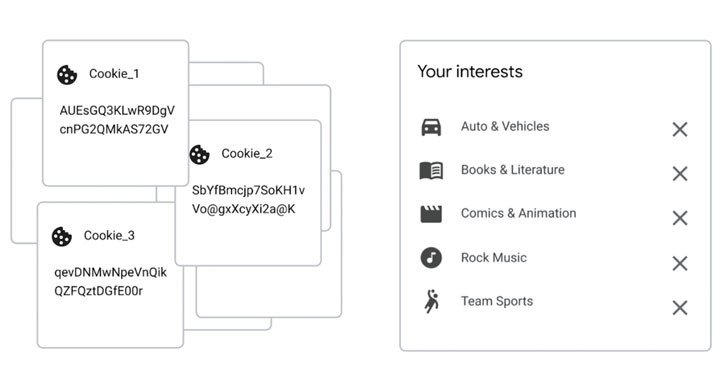
new Privacy Sandbox proposal called Topics[1], which categorizes
users’ browsing habits into approximately 350 topics.
Thee new[2]
framework[3], which takes the place
of FLoC[4]
(short for Federated Learning of Cohorts), slots users’ browsing
history for a given week into a handful of top pre-designated
interests (i.e., topics), which are retained only on the device for
a revolving period of three weeks.
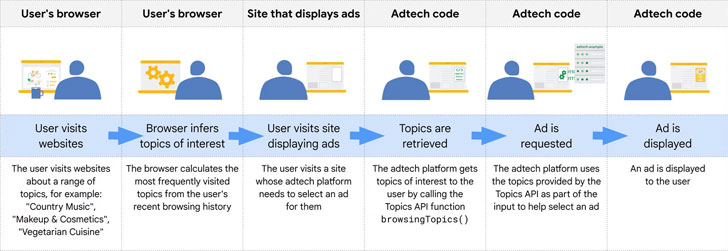
Subsequently, when a user visits a participating site, the
Topics selects three of the interests — one topic from each of the
past three weeks — to share with the site and its advertising
partners. To give more control over the framework, users can not
only see the topics but also remove topics or disable it
altogether.
By labeling each website with a recognizable, high-level topic
and sharing the most frequent topics associated with the browsing
history, the idea is to facilitate interest-based advertising by
showing users more relevant ads, without needing to know the
specific sites that have been visited.
Topics, which is expected to be launched as a developer trial in
Chrome browser, employs machine learning to infer topics from
hostnames and is designed to exclude sensitive categories, such as
sexual orientation, religion, gender, or race, Google pointed
out.
“Because Topics is powered by the browser, it provides you with
a more recognizable way to see and control how your data is shared,
compared to tracking mechanisms like third-party cookies,” Vinay
Goel, privacy director of Privacy Sandbox, said[5].
“And, by providing websites with your topics of interest, online
businesses have an option that doesn’t involve covert tracking
techniques, like browser fingerprinting, in order to continue
serving relevant ads,” Goel added.
The development comes exactly seven months after Google said it
was delaying[6]
the rollout from early 2022 to late 2023 in June 2021 following
blowback from privacy advocates, prompting the company to
acknowledge that “more time is needed across the ecosystem to get
this right.”
Topics also hopes to rework some of the core concerns[7]
with FLoC, which was branded by the Electronic Frontier Foundation
(EFF) as a terrible idea that created more privacy risks for
users.
Particularly, FLoC drew criticism for constructing “cohorts”
from a combination of different online interests that could lead to
classifying users in a manner that could increase the risk of
discrimination. What’s more, should a cohort be deemed too small,
then it could be combined with other tracking information to
identify an individual, effectively undermining the privacy
protections uniquely.
The overhaul is part of the search giant’s plans to replace
third-party cookies over privacy concerns. Privacy Sandbox, as the
efforts are called, aim to develop privacy-focused alternatives
that restrict tracking of users on the web while also maintaining
existing web capabilities, including advertising.
References
Read more https://thehackernews.com/2022/01/google-drops-floc-and-introduces-topics.html