
Microsoft on Wednesday disclosed details of a new security
vulnerability in SolarWinds Serv-U software that it said was being
weaponized by threat actors to propagate attacks leveraging the
Log4j flaws to compromise targets.
Tracked as CVE-2021-35247[1]
(CVSS score: 5.3), the issue is an “input validation vulnerability
that could allow attackers to build a query given some input and
send that query over the network without sanitation,” Microsoft
Threat Intelligence Center (MSTIC) said[2].
The flaw, which was discovered by security researcher Jonathan
Bar Or, affects Serv-U versions 15.2.5 and prior, and has been
addressed in Serv-U version 15.3.
“The Serv-U web login screen to LDAP authentication was allowing
characters that were not sufficiently sanitized,” SolarWinds
said[3]
in an advisory, adding it “updated the input mechanism to perform
additional validation and sanitization.”
The IT management software maker also pointed out that “no
downstream effect has been detected as the LDAP servers ignored
improper characters.” It’s not immediately clear if the attacks
detected by Microsoft were mere attempts to exploit the flaw or if
they were ultimately successful.
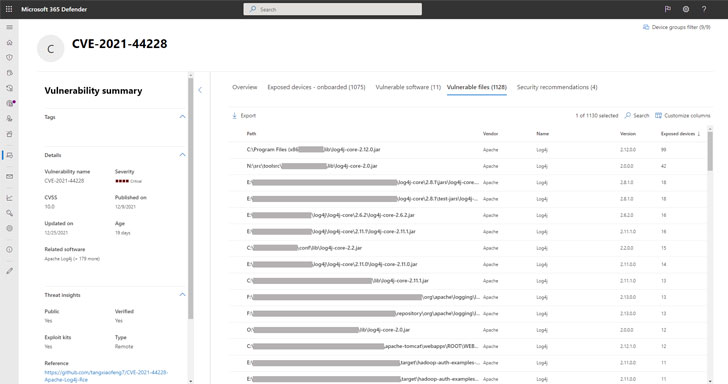
The development comes as multiple threat actors continue to take
advantage of the Log4Shell flaws[4]
to mass scan and infiltrate vulnerable networks for deploying
backdoors, coin miners, ransomware, and remote shells that grant
persistent access for further post-exploitation activity.
Akamai researchers, in an analysis[5]
published this week, also found evidence of the flaws being abused
to infect and assist in the proliferation of malware used by the
Mirai botnet by targeting Zyxel networking devices[6].
On top of this, a China-based hacking group has been previously
observed exploiting a critical security vulnerability affecting
SolarWinds Serv-U (CVE-2021-35211[7]) to install malicious
programs on the infected machines.
Update: In a statement shared with The
Hacker News, SolarWinds pointed out that its Serv-U software wasn’t
exploited in the Log4j attacks, and that attempts were made to log
in to SolarWinds Serv-U file-sharing software via attacks
exploiting the Log4j flaws.
“The activity Microsoft was referring to in their report was
related to a threat actor attempting to login to Serv-U using the
Log4j vulnerability but that attempt failed as Serv-U does not
utilize Log4j code and the target for authentication LDAP
(Microsoft Active Directory) is not susceptible to Log4J attacks,”
a company spokesperson said.
While this directly contradicts Microsoft’s original disclosure
that attackers were exploiting the previously undisclosed
vulnerability in the SolarWinds Serv-U managed file transfer
service to propagate Log4j attacks, the attempts ultimately failed
because the vulnerable Log4j code isn’t present in the
software.
(The story has been revised to to clarify that Serv-U is not
vulnerable to the Log4Shell attacks.)
References
- ^
CVE-2021-35247
(nvd.nist.gov) - ^
said
(www.microsoft.com) - ^
said
(www.solarwinds.com) - ^
Log4Shell flaws
(thehackernews.com) - ^
analysis
(www.akamai.com) - ^
Zyxel
networking devices (www.zyxel.com) - ^
CVE-2021-35211
(thehackernews.com)
Read more https://thehackernews.com/2022/01/microsoft-hackers-exploiting-new.html