Latest analysis into the wiper malware that targeted dozens of
Ukrainian agencies earlier this month has revealed “strategic
similarities” to NotPetya malware[1]
that was unleashed against the country’s infrastructure and
elsewhere in 2017.
The malware, dubbed WhisperGate[2], was discovered by
Microsoft last week, which said it observed the destructive cyber
campaign targeting government, non-profit, and information
technology entities in the nation, attributing the intrusions to an
emerging threat cluster codenamed “DEV-0586.”
“While WhisperGate has some strategic similarities to the
notorious NotPetya wiper that attacked Ukranian entities in 2017,
including masquerading as ransomware and targeting and destroying
the master boot record (MBR) instead of encrypting it, it notably
has more components designed to inflict additional damage,” Cisco
Talos said[3]
in a report detailing its response efforts.
Stating that stolen credentials were likely used in the attack,
the cybersecurity company also pointed out that the threat actor
had access to some of the victim networks months in advance before
the infiltrations took place, a classic sign of sophisticated APT
attacks.
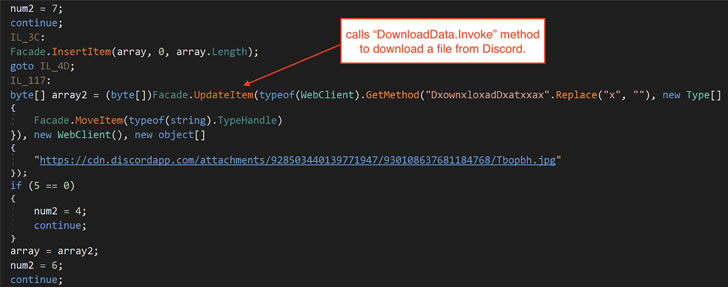
The WhisperGate infection chain is fashioned as a multi-stage
process that downloads a payload that wipes the master boot record
(MBR[4]), then downloads a
malicious DLL file hosted on a Discord server, which drops and
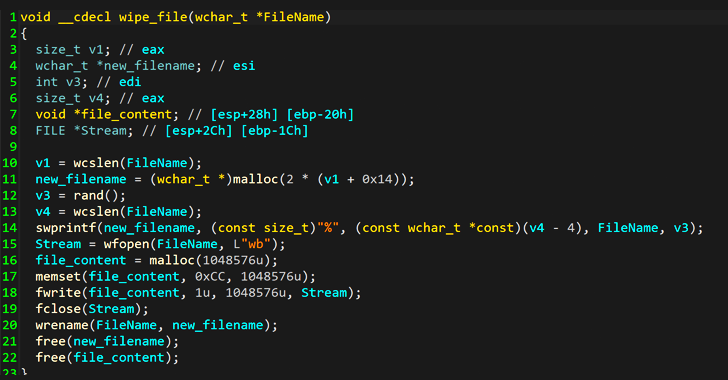
executes another wiper payload that irrevocably destroys files by
overwriting their content with fixed data on the infected
hosts.
The findings come a week after roughly 80 Ukrainian government agencies’ websites[5] were defaced, with the
Ukrainian intelligence agencies confirming that the twin incidents
are part of a wave of malicious activities[6] targeting its critical
infrastructure, while also noting that the attacks leveraged the
recently disclosed Log4j vulnerabilities to gain access to some of
the compromised systems.
“Russia is using the country as a cyberwar testing ground — a
laboratory for perfecting new forms of global online combat,”
Wired’s Andy Greenberg noted[7]
in a 2017 deep-dive about the attacks that took aim at its power
grid in late 2015 and caused unprecedented blackouts.
“Systems in Ukraine face challenges that may not apply to those
in other regions of the world, and extra protections and
precautionary measures need to be applied,” Talos researchers said.
“Making sure those systems are both patched and hardened is of the
utmost importance to help mitigate the threats the region
faces.”
References
- ^
NotPetya
malware (www.wired.com) - ^
WhisperGate
(thehackernews.com) - ^
said
(blog.talosintelligence.com) - ^
MBR
(en.wikipedia.org) - ^
government agencies’ websites
(thehackernews.com) - ^
wave of
malicious activities (thehackernews.com) - ^
noted
(www.wired.com)
Read more https://thehackernews.com/2022/01/experts-find-strategic-similarities-bw.html