A threat actor with potential links to an Indian cybersecurity
company has been nothing if remarkably persistent in its attacks
against military organizations based in South Asia, including
Bangladesh, Nepal, and Sri Lanka, since at least September 2020 by
deploying different variants of its bespoke malware framework.
Slovak cybersecurity firm ESET attributed the highly targeted
attack to a hacking group known as Donot Team[1]. “Donot Team has been
consistently targeting the same entities with waves of
spear-phishing emails with malicious attachments every two to four
months,” researchers Facundo Muñoz and Matías Porolli said[2].
Operating since at least 2016, Donot Team (also known as
APT-C-35 and SectorE02) has been linked to a string of intrusions
primarily targeting embassies, governments, and military entities
in Bangladesh, Sri Lanka, Pakistan, and Nepal with Windows and
Android malware.
In October 2021, Amnesty International unearthed evidence[3]
tying the group’s attack infrastructure to an Indian cybersecurity
company called Innefu Labs, raising suspicions that the threat
actor may be selling the spyware or offering a hackers-for-hire
service to governments of the region.
While it’s not uncommon for APT groups to re-attack a previously
compromised network by deploying stealthier backdoors to cover up
their tracks, Donot Team tries a different tack in that it deploys
multiple variants of the malware already in its arsenal.
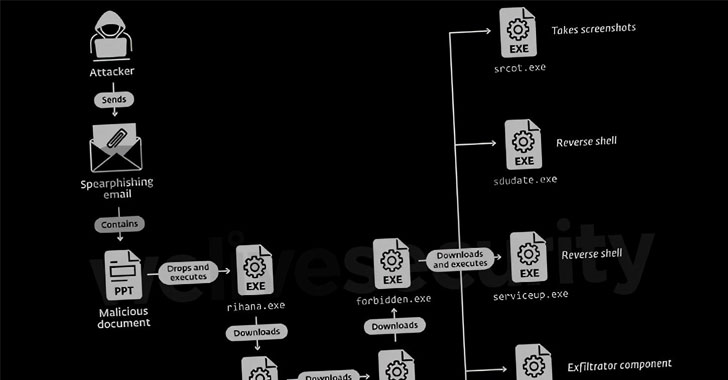
Delivered via weaponized Microsoft Office documents, the
so-called yty malware framework is a chain of intermediary
downloaders that culminates in the execution of a backdoor, which
takes care of retrieving additional components capable of
harvesting files, recording keystrokes and screenshots, and
deploying reverse shells for remote access.
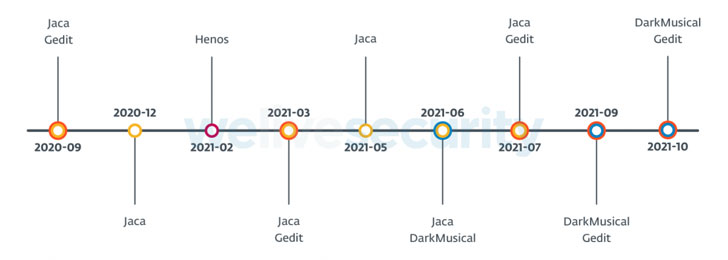
ESET dubbed the new variants of yty, DarkMusical and Gedit, with
telemetry data pointing to attacks from a third variant called
Jaca[4]
from March to July 2021. The first wave of attacks using
DarkMusical is said to have occurred in June 2021, while
Gedit-related campaigns were observed as early as September 2020,
only to pick up the pace a year later.
What’s more, a fourth set of attacks that happened between
February and March 2021 targeting military organizations in
Bangladesh and Sri Lanka leveraged a modified version of Gedit
codenamed Henos.
“Donot Team makes up for its low sophistication with tenacity,”
the researchers concluded. “We expect that it will continue to push
on regardless of its many setbacks. Only time will tell if the
group evolves its current TTPs and malware.”
References
- ^
Donot
Team (malpedia.caad.fkie.fraunhofer.de) - ^
said
(www.welivesecurity.com) - ^
unearthed evidence
(thehackernews.com) - ^
Jaca
(cn-sec.com)
Read more https://thehackernews.com/2022/01/donot-hacking-team-targeting-government.html