The financially motivated FIN8 actor[1], in all likelihood, has
resurfaced with a never-before-seen ransomware strain called
“White Rabbit” that was recently deployed against
a local bank in the U.S. in December 2021.
That’s according to new findings published by Trend Micro,
calling out the malware’s overlaps with Egregor, which was taken
down by Ukrainian law enforcement authorities in February 2021.
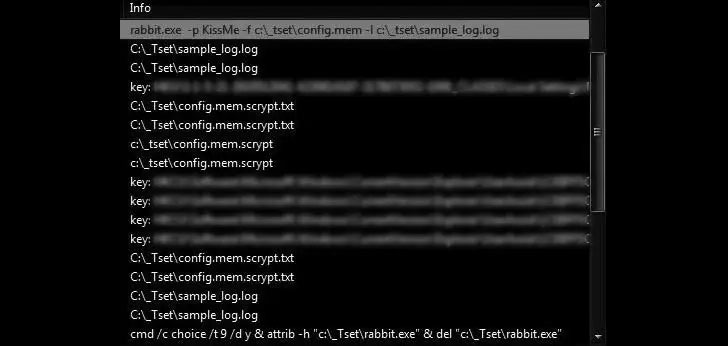
“One of the most notable aspects of White Rabbit’s attack is how
its payload binary requires a specific command-line password to
decrypt its internal configuration and proceed with its ransomware
routine,” the researchers noted[2]. “This method of hiding
malicious activity is a trick that the ransomware family Egregor
uses to hide malware techniques from analysis.”
Egregor, which commenced operations in September 2020 until its
operations took a huge hit, is widely believed to be a reincarnation of Maze[3], which shut down its
criminal enterprise later that year.
Besides taking a leaf out of Egregor’s playbook, White Rabbit
adheres to the double extortion scheme and is believed to have been
delivered via Cobalt Strike, a post-exploitation framework that’s
put to use by threat actors to reconnoiter, infiltrate, and drop
malicious payloads into the affected system.
Double extortion, also known as pay-now-or-get-breached, refers
to an increasingly popular ransomware strategy in which valuable
data from the targets is exfiltrated prior to launching the
encryption routine, followed by pressurizing the victims into
paying up to prevent the stolen information from being published
online.
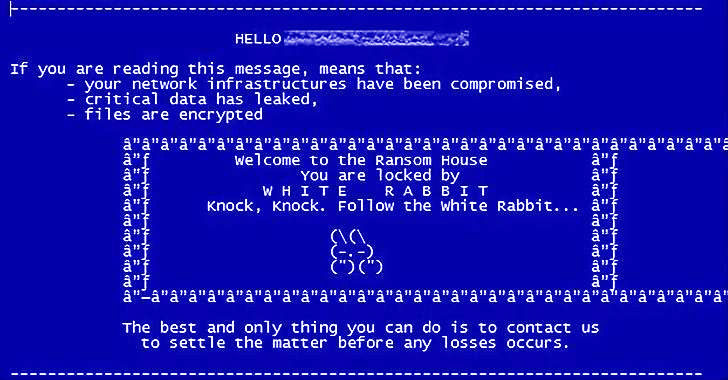
Indeed, the ransom note displayed after the completion of the
encryption process warns the victim that their data will be
published or sold once the four-day deadline to meet their demands
elapses. “We will also send the data to all interested supervisory
organizations and the media,” the note adds.
Although real-world attacks involving White Rabbit have gained
attention only recently, digital forensic clues piecing together
its trail points to a string of malicious activities commencing as
early as July 2021.
What’s more, analysis of the ransomware samples dating back to
August 2021 shows that the malware is an updated version of the
Sardonic backdoor[4], which Bitdefender
described last year as an actively developed malware encountered in
the aftermath of an unsuccessful attack targeting a financial
institution in the U.S.
“The exact relationship between the White Rabbit group and FIN8
is currently unknown,” cybersecurity company Lodestone said[5], adding it found a
“number of TTPs suggesting that White Rabbit, if operating
independently of FIN8, has a close relationship with the more
established threat group or is mimicking them.”
“Given that FIN8 is known mostly for its infiltration and
reconnaissance tools, the connection could be an indication of how
the group is expanding its arsenal to include ransomware,” Trend
Micro said. “So far, White Rabbit’s targets have been few, which
could mean that they are still testing the waters or warming up for
a large-scale attack.”
References
- ^
FIN8
actor (thehackernews.com) - ^
noted
(www.trendmicro.com) - ^
reincarnation of Maze
(intel471.com) - ^
Sardonic
backdoor (thehackernews.com) - ^
said
(lodestone.com)
Read more https://thehackernews.com/2022/01/fin8-hackers-spotted-using-new-white.html