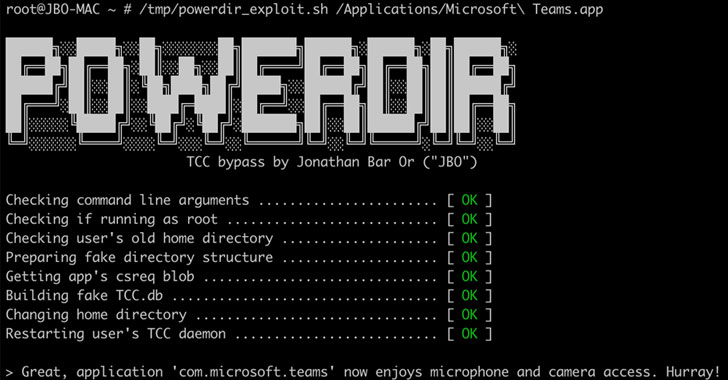
Microsoft on Monday disclosed details of a recently patched
security vulnerability in Apple’s macOS operating system that could
be weaponized by a threat actor to expose users’ personal
information.
Tracked as CVE-2021-30970, the flaw concerns a logic issue in
the Transparency, Consent and Control (TCC) security framework,
which enables users to configure the privacy settings of their apps
and provide access to protected files and app data. The Security & Privacy pane[1]
in the macOS System Preferences app serves as the front end of
TCC.
Microsoft 365 Defender Research Team, which reported the flaw to
Apple on July 15, 2021, dubbed the flaw
“powerdir.” Apple addressed[2]
the issue as part of macOS 11.6 and 12.1 updates released in
December 2021 with improved state management.
While Apple does enforce a policy that limits access to TCC to
only apps with full disk access, it’s possible to orchestrate an
attack wherein a malicious application could work around its
privacy preferences to retrieve sensitive information from the
machine, potentially allowing an adversary to access microphone to
record private conversations or capture screenshots of sensitive
information displayed on the user’s screen.
“We discovered that it is possible to programmatically change a
target user’s home directory and plant a fake TCC database, which
stores the consent history of app requests,” Jonathan Bar Or of
Microsoft 365 Defender Research Team said[3]. “If exploited on
unpatched systems, this vulnerability could allow a malicious actor
to potentially orchestrate an attack based on the user’s protected
personal data.”
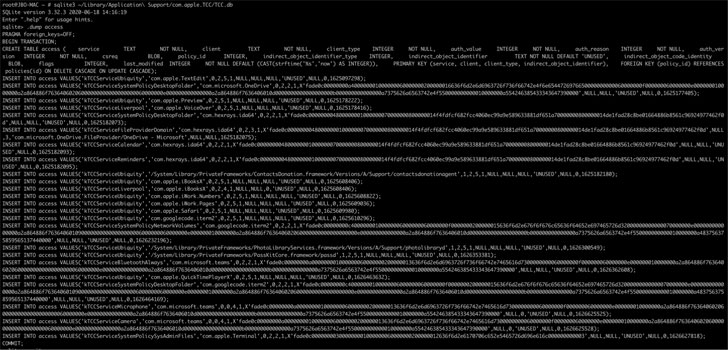
In other words, if a bad actor gains full disk access to the TCC
databases, the intruder could edit it to grant arbitrary
permissions to any app of their choice, including their own,
effectively permitting the app run with configurations previously
not consented to.
CVE-2021-30970 is also the third TCC-related bypass
vulnerability to be discovered after CVE-2020-9934[4]
and CVE-2020-27937[5], both of which have
since been remediated by Apple. Then in May 2021, the company also
patched a then zero-day flaw in the same component (CVE-2021-30713[6]) that could allow an
attacker to gain full disk access, screen recording, or other
permissions without users’ explicit consent.
“This shows that even as macOS or other operating systems and
applications become more hardened with each release, software
vendors like Apple, security researchers, and the larger security
community, need to continuously work together to identify and fix
vulnerabilities before attackers can take advantage of them,” Bar
Or said.
References
- ^
Security
& Privacy pane (support.apple.com) - ^
addressed
(thehackernews.com) - ^
said
(www.microsoft.com) - ^
CVE-2020-9934
(nvd.nist.gov) - ^
CVE-2020-27937
(nvd.nist.gov) - ^
CVE-2021-30713
(thehackernews.com)
Read more https://thehackernews.com/2022/01/microsoft-details-macos-bug-that-could.html