A North Korean cyberespionage group named Konni has been linked
to a series of targeted attacks aimed at the Russian Federation’s
Ministry of Foreign Affairs (MID) with New Year lures to compromise
Windows systems with malware.
“This activity cluster demonstrates the patient and persistent
nature of advanced actors in waging multi-phased campaigns against
perceived high-value networks,” researchers from Lumen
Technologies’ Black Lotus Labs said[1]
in an analysis shared with The Hacker News.
The Konni group’s tactics, techniques, and procedures (TTPs) are
known to overlap with threat actors belonging to the broader
Kimsuky[2]
umbrella, which is also tracked by the cybersecurity community
under the monikers Velvet Chollima, ITG16, Black Banshee, and
Thallium.
The most recent attacks involved the actor gaining access to the
target networks through stolen credentials, exploiting the foothold
to load malware for intelligence gathering purposes, with early
signs of the activity documented[3]
by MalwareBytes as far back as July 2021.
Subsequent iterations of the phishing campaign are believed to
have unfolded in three waves — the first commencing on October 19,
2021 to harvest credentials from MID personnel, followed by
leveraging COVID-19 themed lures in November to install a rogue
version of the Russian-mandated vaccination registration software
that served as a loader for additional payloads.
“The timing of this activity closely aligned with the passage of
Russian Vaccine Passport laws[4] that mandated Russians
had to receive a QR code from the government to prove vaccination
in order to access public places such as restaurants and bars,” the
researchers noted.
The third attack, also corroborated by Cluster25[5]
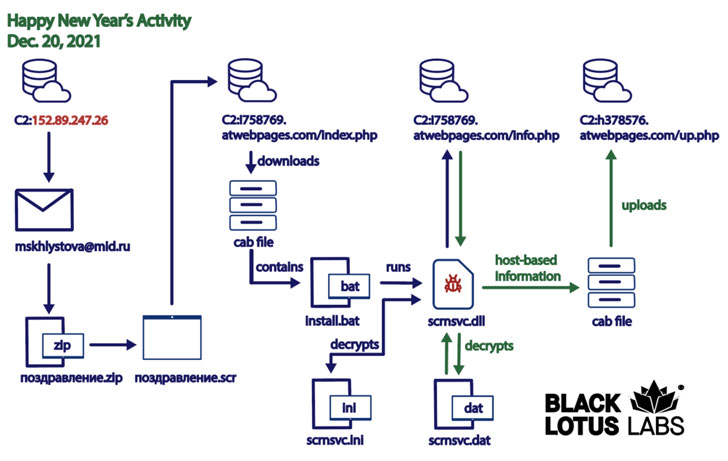
earlier this week, began on December 20, 2021, using New Year’s Eve
festivities as a spear-phishing theme to trigger a multi-stage
infection chain that culminated in the installation of a remote
access trojan named Konni RAT[6].
Specifically, the intrusions transpired by first compromising
the email account belonging to a staff member of the MID, from
which emails were sent to at least two other MID entities,
including the Russian Embassy in Indonesia and Sergey Alexeyevich Ryabkov[7], a deputy minister
overseeing non-proliferation and arms control.
The email missives seemingly propagated a “Happy New Year’s”
message, only to contain a trojanized screensaver attachment that’s
designed to retrieve and run next-stage executables from a remote
server. The final stage of the attack is the deployment of the
Konni RAT trojan, which conducts reconnaissance of the infected
machine and exfiltrates the collected information back to the
server.
“While this particular campaign was highly targeted, it is vital
for defenders to understand the evolving capabilities of advanced
actors to achieve infection of coveted targets,” the researcher
said, urging organizations to watch out for phishing emails and use
multi-factor authentication to secure accounts.
References
- ^
said
(blog.lumen.com) - ^
Kimsuky
(thehackernews.com) - ^
documented
(blog.malwarebytes.com) - ^
Russian
Vaccine Passport laws (www.reuters.com) - ^
Cluster25
(cluster25.io) - ^
Konni
RAT (malpedia.caad.fkie.fraunhofer.de) - ^
Sergey
Alexeyevich Ryabkov
(webcache.googleusercontent.com)
Read more https://thehackernews.com/2022/01/north-korean-hackers-start-new-year.html