When I want to know the most recently published best practices
in cyber security, I visit The National Institute of Standards and
Technology (NIST). From the latest password requirements (NIST
800-63) to IoT security for manufacturers (NISTIR 8259), NIST is
always the starting point. NIST plays a key role as a US
standard-setter, due to the organization’s professionalism and the
external experts who help to create NIST documents.
The NIST Cybersecurity Framework (CSF) was initially released in
2014 and last updated in 2018. The framework enables organizations
to improve the security and resilience of critical infrastructure
with a well-planned and easy-to-use framework.
The continuing growth in SaaS, and the major changes to the work
environment due to COVID-19 bring new security challenges. Although
the CSF was written and updated while SaaS was on the rise, it is
still geared towards the classic legacy critical infrastructure
security challenges. However, organizations can better respond to
new risks by adapting the CSF to modern, SaaS-based work
environments.
I personally love this Framework, but truth be told, when one
reads the Framework in-depth, its complexity is apparent, and
following it can be difficult. This article will review the CSF’s
key elements, point out its key merits, and suggest implementations
for SaaS security.
Learn how to automate your organization’s
NIST compliance[1]
Overview of NIST CSF
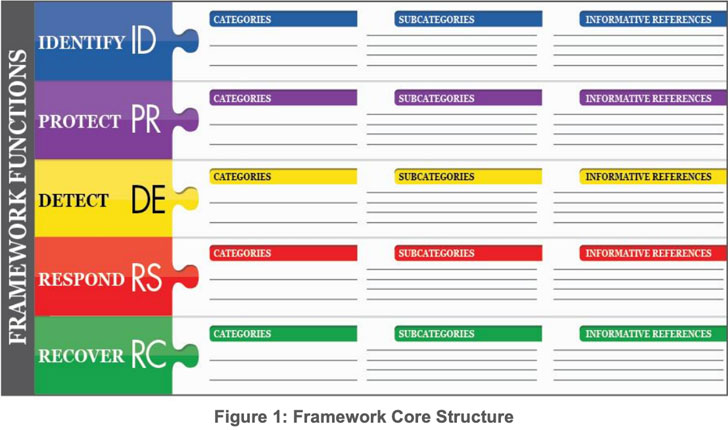
The NIST CSF lays out five functions of security, then splits
them into categories and subcategories. The subcategories contain
the actual controls. For each subcategory, the CSF includes a list
of cross-references to well-known standards and frameworks such as
ISO 27001, COBIT, NIST SP 800-53, and ANSI/ISA-62443.
These cross-references help organizations implement the CSF and
map it to other frameworks. For example, security managers or other
team members can use the references to justify their decisions no
matter what security standard the company needs to comply with.
In a single document, the Framework combines a host of
approaches to dealing with cyber security threats. This
includes:
- setting up procedures
- training
- defining roles
- auditing
- monitoring
The framework has a five-stage core structure: Identify,
Protect, Detect, Respond and Recover. I’m going to break them down
into bullets for you.
Identify
NIST defines this function as follows:
“Develop the organizational understanding to manage
cybersecurity risk to systems, assets, data, and capabilities.”
Within this function, NIST includes the following control
categories:
- Asset Management
- Business Environment
- Governance
- Risk Assessment
- Risk Management Strategy
- Supply Chain Risk Management.
Protect
NIST defines this function as follows:
“Develop and implement the appropriate safeguards to ensure
delivery of critical infrastructure services.”
Within this function, NIST includes the following control
categories:
- Access Control
- Awareness and Training
- Data Security
- Information Protection Processes and Procedures
- Maintenance
- Protective Technology
Detect
NIST defines this function as follows:
“Develop and implement the appropriate activities to identify
the occurrence of a cybersecurity event”.
Within this function, NIST includes the following control
categories:
- Anomalies and Events
- Security Continuous Monitoring
- Detection Processes
Respond
NIST defines this function as follows:
“Develop and implement the appropriate activities to take action
regarding a detected cybersecurity event”.
Within this function, NIST includes the following control
categories:
- Response Planning
- Communications
- Analysis
- Mitigation
- Improvements
Recover
NIST defines this function as follows:
“Develop and implement the appropriate activities to maintain
plans for resilience and to restore any capabilities or services
that were impaired due to a cybersecurity event”.
Within this function, NIST includes the following control
categories:
- Recovery Planning
- Improvements
- Communications
Applying the CSF to SaaS Security
While definitely a model in best practices, the Framework is a
challenge to implement.
Learn more how a SaaS Security Posture
Management (SSPM) solution can automate compliance to NIST across
your SaaS estate.[2]
Data-in-transit is protected (PR.DS-2)
A company using SaaS services may wonder how this is relevant
for them. They may think that compliance is the SaaS provider’s
responsibility. However, a deeper look into it shows that many SaaS
providers have security measures in place, and the user is
responsible for using them.
For example, admins should not allow any connections via HTTP to
a SaaS service. They should only allow secure HTTPS
connections.
Protections against data leaks are implemented (PR.DS-5)
This may seem like a small subcategory, but underneath there is
a behemoth. Data leaks are extremely difficult to prevent. SaaS
application adoption makes this harder because people can share and
access them from anywhere in the world.
An admin or member of the CISO office should take special care
of this threat. DLP in SaaS can include security measures such
as:
- sharing links to files rather than the actual file
- setting an expiration date for the link
- disabling the download option if not needed
- blocking the ability to export data in data analysis SaaS
- user authentication hardening
- prevention of locale recording in communication SaaS
- well-defined user roles with a limited number of super users
and admins
Identities and credentials are issued, managed, verified,
revoked, and audited for authorized devices, users and processes
(PR.AC-1)
As an enterprise scales its workforce and SaaS adoption, this
subcategory becomes more challenging. Managing 50,000 users over
just five SaaS means that the security team needs to manage 250,000
identities. This problem is real and complicated.
Even more challenging, each SaaS has a different way to define
identities, view them, and secure identities. Adding to the risk,
SaaS applications don’t always integrate with each other, which
means users can find themselves with different privileges across
different systems. This then leads to unnecessary privileges that
can create a potential security risk.
How Adaptive Shield Can Help Meet NIST CSF Requirements
The NIST CSF is an industry-standard for cybersecurity today,
yet to implement it with typical manual practices and processes is
an uphill battle. So why not automate?
Adaptive Shield is a SaaS Security Posture Management (SSPM)
solution[3] that can automate the
compliance and configuration checks across the SaaS estate.
Adaptive Shield enables security teams to easily see and fix
configuration weaknesses quickly, ensuring compliance with company
and industry standards, from NIST CSF, as well as other compliance
mandates such as SOC 2 and the CSA Cloud Controls Matrix.
References
- ^
Learn
how to automate your organization’s NIST compliance
(www.adaptive-shield.com) - ^
Learn
more how a SaaS Security Posture Management (SSPM) solution can
automate compliance to NIST across your SaaS estate.
(www.adaptive-shield.com) - ^
SaaS
Security Posture Management (SSPM) solution
(www.adaptive-shield.com)
Read more https://thehackernews.com/2022/01/nist-cybersecurity-framework-quick.html