
Cybersecurity researchers have taken the wraps of an organized
financial-theft operation undertaken by a discreet actor to target
transaction processing systems and siphon funds from entities
primarily located in Latin America for at least four years.
The malicious hacking group has been codenamed Elephant
Beetle by Israeli incident response firm Sygnia, with the
intrusions aimed at banks and retail companies by injecting
fraudulent transactions among benign activity to slip under the
radar after an extensive study of the targets’ financial
structures.
“The attack is relentless in its ingenious simplicity serving as
an ideal tactic to hide in plain sight, without any need to develop
exploits,” the researchers said in a report[1]
shared with The Hacker News, calling out the group’s overlaps with
another tracked by Mandiant as FIN13[2], an “industrious” threat
actor linked to data theft and ransomware attacks in Mexico
stretching back as early as 2016.
Elephant Beetle is said to leverage an arsenal of no fewer than
80 unique tools and scripts to execute its attacks, while
simultaneously taking steps to blend in with the victim’s
environment over long periods to achieve its objectives.
“The unique modus operandi associated with the Elephant Beetle
is their deep research and knowledge of victim’s financial systems
and operations and their persistent search for vulnerable methods
to technically inject financial transactions, ultimately leading to
major financial theft,” Arie Zilberstein, vice president of
incident response at Sygnia, told The Hacker News. “Given the long
period of persistence this group has in victim’s networks, they
often change and adapt their techniques and tooling to continue to
be relevant.”
Zilberstein attributed the success of the campaign to the vast
attack surface provided by legacy systems that are present in
financial institutions’ networks and can serve as entry points,
thereby enabling attackers to gain a permanent foothold into target
networks.
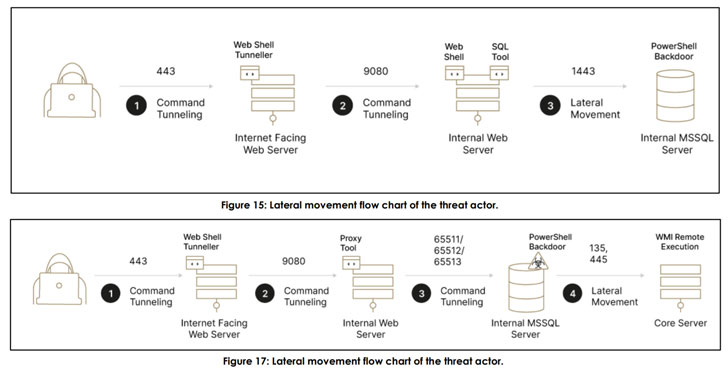
The adversary’s modus operandi follows a low-profile pattern
that begins with planting backdoors to study the victim’s
environment, specifically with an aim to understand the various
processes used to facilitate financial transactions, followed by
inserting rogue transactions of its own into the network that steal
incremental amounts of money from the target to avoid setting off
alarm.
But in the event the actor’s fraudulent actions come to light,
they temporarily cease their operations only to return a few months
later. The initial access is brokered by taking advantage of
unpatched flaws in external-facing Java-based web servers such as
WebSphere and WebLogic, ultimately leading to the deployment of web
shells that enable remote code execution and lateral movement —
- CVE-2017-1000486[3] (CVSS score: 9.8) –
Primefaces Application Expression Language Injection - CVE-2015-7450[4] (CVSS score: 9.8) –
WebSphere Application Server SOAP Deserialization Exploit - CVE-2010-5326[5] (CVSS score: 10.0) – SAP
NetWeaver Invoker Servlet Exploit - EDB-ID-24963[6] – SAP NetWeaver
ConfigServlet Remote Code Execution
“This attack emphasizes once again that sophisticated attackers
are sometimes lurking in networks for [a] long time,” Zilberstein
said. “While a lot of emphasis is given today to avoiding and
preventing the imminent risk of ransomware, some other threat
actors are still operating to stealthily proliferate themselves in
networks to get a long term and steady financial gain.”
“Organizations need to pay extra attention to these systems,
particularly those which are externally facing, and perform
patching and continuous hunting to prevent and detect attacks of
similar nature,” Zilberstein added.
References
- ^
report
(blog.sygnia.co) - ^
FIN13
(malpedia.caad.fkie.fraunhofer.de) - ^
CVE-2017-1000486
(nvd.nist.gov) - ^
CVE-2015-7450
(nvd.nist.gov) - ^
CVE-2010-5326
(nvd.nist.gov) - ^
EDB-ID-24963
(www.fortiguard.com)
Read more https://thehackernews.com/2022/01/researchers-uncover-hacker-group-behind.html