Apple recently fixed a security vulnerability in the macOS
operating system that could be potentially exploited by a threat
actor to “trivially and reliably” bypass a “myriad of foundational
macOS security mechanisms” and run arbitrary code.
Security researcher Patrick Wardle detailed[1]
the discovery in a series of tweets on Thursday. Tracked as
CVE-2021-30853 (CVSS score: 5.5), the issue relates to a scenario
where a rogue macOS app may circumvent Gatekeeper[2]
checks, which ensure that only trusted apps can be run and that
they have passed an automated process called “app notarization[3].”
The iPhone maker, crediting Gordon Long of Box with reporting
the flaw, said it addressed the
weakness[4] with improved checks as
part of macOS 11.6 updates officially released on September 20,
2021.
“Such bugs are often particularly impactful to everyday macOS
users as they provide a means for adware and malware authors to
sidestep macOS security mechanisms, …mechanisms that otherwise
would thwart infection attempts,” Wardle said[5]
in a technical write-up of the flaw.
Specifically, the bug not only gets around Gatekeeper, but also
File Quarantine[6]
and macOS’s notarization requirements, effectively allowing a
seemingly innocuous PDF file to compromise the entire system simply
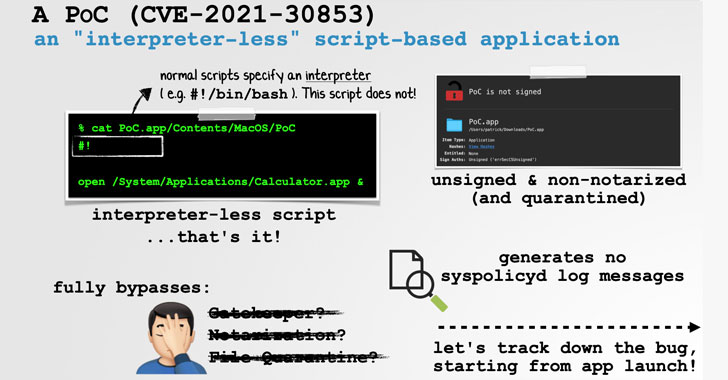
by opening it. According to Wardle, the issue is rooted in the fact
that an unsigned, non-notarized script-based application can
not explicitly specify an interpreter[7], resulting in a complete
bypass.
It’s worth noting that a shebang[8]
interpreter directive — e.g. #!/bin/sh or #!/bin/bash — is
typically used to parse and interpret a shell program. But in this
edge-case attack, an adversary can craft an application such that
the shebang line is incorporated without providing an interpreter
(i.e., #!) and still get the underlying operating system to launch
the script without raising any alert.
This is so because “macOS will (re)attempt to execute the failed
[‘interpreter-less’ script-based app] via the shell (‘/bin/sh’)”
after the initial lack of success, Wardle explained.
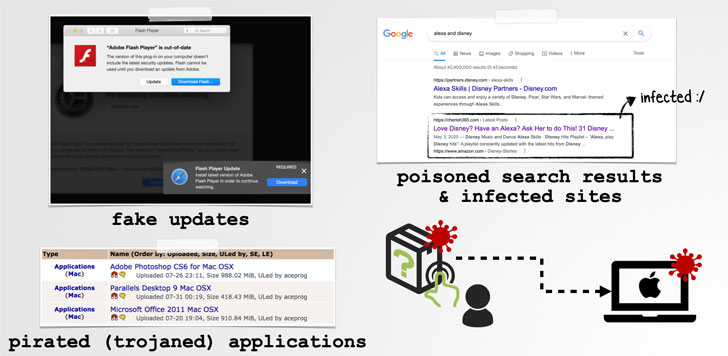
In other words, threat actors can exploit this flaw by tricking
their targets into opening a rogue app that can be camouflaged as
Adobe Flash Player updates or trojanized versions of legitimate
apps like Microsoft Office, which, in turn, can be delivered
through a method called search poisoning where attackers
artificially increase the search engine ranking of websites hosting
their malware to lure potential victims.
This is not the first time flaws have been discovered in the
Gatekeeper process. Earlier this April, Apple moved to quickly
patch a then actively exploited zero-day flaw (CVE-2021-30657[9]) that could circumvent
all security protections, thus permitting unapproved software to be
run on Macs.
Then in October, Microsoft disclosed a vulnerability dubbed
“Shrootless” (CVE-2021-30892[10]), which could be
leveraged to perform arbitrary operations, elevate privileges to
root, and install rootkits on compromised devices. Apple said[11] it remediated the
problem with additional restrictions as part of security updates
pushed on October 26, 2021.
References
- ^
detailed
(twitter.com) - ^
Gatekeeper
(support.apple.com) - ^
app
notarization (developer.apple.com) - ^
addressed the weakness
(support.apple.com) - ^
said
(objective-see.com) - ^
File
Quarantine (objective-see.com) - ^
interpreter
(en.wikipedia.org) - ^
shebang
(en.wikipedia.org) - ^
CVE-2021-30657
(thehackernews.com) - ^
CVE-2021-30892
(thehackernews.com) - ^
said
(support.apple.com)
Read more https://thehackernews.com/2021/12/expert-details-macos-bug-that-could-let.html