
Researchers have disclosed security vulnerabilities in handover,
a fundamental mechanism that undergirds modern cellular networks,
which could be exploited by adversaries to launch denial-of-service
(DoS) and man-in-the-middle (MitM) attacks using low-cost
equipment.
The “vulnerabilities in the handover procedure are not limited
to one handover case only but they impact all different handover
cases and scenarios that are based on unverified measurement
reports and signal strength thresholds,” researchers Evangelos
Bitsikas and Christina Pöpper from the New York University Abu
Dhabi said in a new paper[1]. “The problem affects
all generations since 2G (GSM), remaining unsolved so far.”
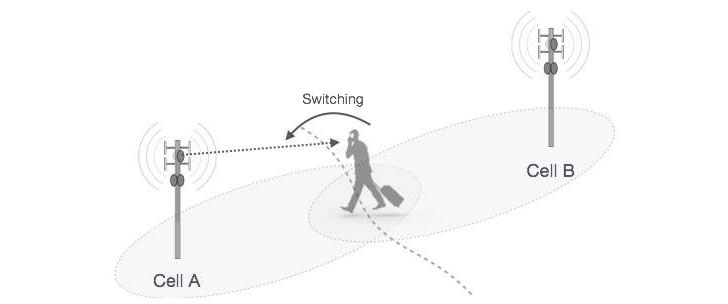
Handover[2], also known as handoff,
is a process in telecommunications in which a phone call or a data
session is transferred from one cell
site[3] (aka base station) to
another cell tower without losing connectivity during the
transmission. This method is crucial to establishing cellular
communications, especially in scenarios when the user is on the
move.
The routine typically works as follows: the user equipment
(UE) sends signal strength
measurements to the network to determine if a handover is necessary
and, if so, facilitates the switch when a more suitable target
station is discovered.
While these signal readings are cryptographically protected, the
content in these reports is themselves not verified, thus allowing
an attacker to force the device to move to a cell site operated by
the attacker. The crux of the attack lies in the fact that the
source base station is incapable of handling incorrect values in
the measurement report, raising the possibility of a malicious
handover without being detected.
The new fake base station attacks, in a nutshell, render
vulnerable the handover procedures, which are based on the
aforementioned encrypted measurement reports and signal power
thresholds, effectively enabling the adversary to establish a MitM
relay and even eavesdrop, drop, modify, and forward messages
transmitted between the device and the network.
“If an attacker manipulates the content of the [measurement
report] by including his/her measurements, then the network will
process the bogus measurements,” the researchers said. “This is
possible by imitating a legitimate base station and replaying its
broadcast messages.”
“Attracting” the device to a fake base station
The starting point of the attack is an initial reconnaissance
phase wherein the threat actor utilizes a smartphone to collect
data pertaining to nearby legitimate stations and then uses this
information to configure a rogue base station that impersonates a
genuine cell station.
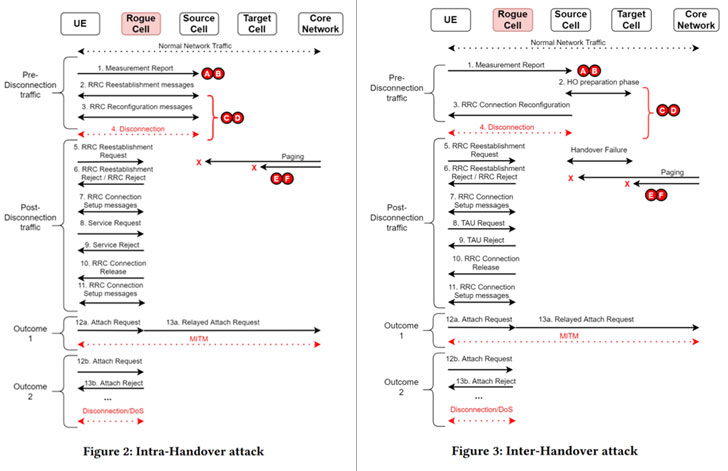
The attack subsequently involves forcing a victim’s device to
connect to the false station by broadcasting master information
block (MIB) and system information block (SIB) messages —
information necessary to help the phone connect to the network —
with a higher signal strength than the emulated base station.
In tricking the UEs to connect to the imposter station and
forcing the devices to report bogus measurements to the network,
the goal is to trigger a handover event and exploit security flaws
in the process to result in DoS, MitM attacks, and information
disclosure affecting the user as well as the operator. This not
only compromises users’ privacy but also puts service availability
at risk.
“When the UE is in the coverage area of the attacker, the rogue
base station has high enough signal power to ‘attract’ the UE and
trigger a [measurement report], then the attacker has very good
chances of forcing the victim UE to attach to his/her rogue base
station [by] abusing the handover procedure,” the researchers
explained.
“Once, the UE is attached to the attacker it could either enter
in a camped mode due to a denial-of-service (DoS) attack and become
unresponsive, or the attacker could establish a man-in-the-middle
(MitM) relay building the basis for other advanced exploits.”
As many as six security vulnerabilities have been identified in
the handover process —
- Insecure broadcast messages (MIB, SIB)
- Unverified measurement reports
- Missing cross-validation in the preparation phase
- Random-access channel (RACH[4]) initiation without
verification - Missing recovery mechanism, and
- Difficulty of distinguishing network failures from attacks
In an experimental setup, the researchers found all the test
devices, including OnePlus 6, Apple iPhone 5, Samsung S10 5G, and
Huawei Pro P40 5G, to be susceptible to DoS and MitM attacks. The
findings were presented at the Annual Computer Security
Applications Conference (ACSAC[5]) held earlier this
month.
References
Read more https://thehackernews.com/2021/12/new-mobile-network-vulnerabilities.html