
Malicious actors are deploying a previously undiscovered binary,
an Internet Information Services (IIS[1]) webserver module dubbed
“Owowa,” on Microsoft Exchange Outlook Web Access servers
with the goal of stealing credentials and enabling remote command
execution.
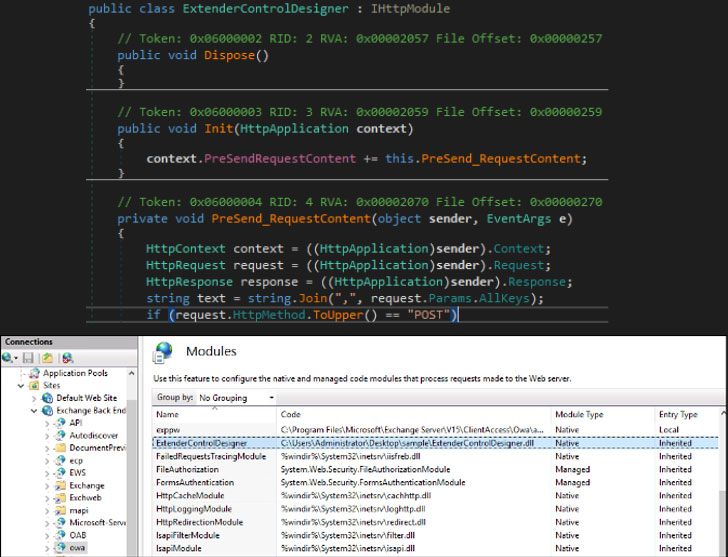
“Owowa is a C#-developed .NET v4.0 assembly that is intended to
be loaded as a module within an IIS web server that also exposes
Exchange’s Outlook Web Access (OWA),” Kaspersky researchers Paul
Rascagneres and Pierre Delcher said[2]. “When loaded this way,
Owowa will steal credentials that are entered by any user in the
OWA login page, and will allow a remote operator to run commands on
the underlying server.”
The idea that a rogue IIS module can be fashioned as a backdoor
is not new. In August 2021, Slovak cybersecurity company ESET’s
study of the IIS landscape revealed[3]
as many as 14 malware families that were developed as native IIS
modules in an attempt to intercept HTTP traffic and remotely
commandeer the compromised computers.
As a persistent component on the compromised system, Owawa is
engineered to capture the credentials of users who are successfully
authenticated on the OWA authentication web page. Exploitation can
then be achieved by sending “seemingly innocuous requests” to the
exposed web services by entering specifically crafted commands
within the username and password fields in the OWA authentication
page of a compromised server.
Specifically, if the OWA username is “jFuLIXpzRdateYHoVwMlfc,”
Owawa responds back with the encrypted credentials. If the
username, on the other hand, is “dEUM3jZXaDiob8BrqSy2PQO1”, the
PowerShell command typed in the OWA password field is executed, the
results of which are sent back to the attacker.
The Russian security firm said it detected a cluster of targets
with compromised servers located in Malaysia, Mongolia, Indonesia,
and the Philippines that primarily belong to government
organizations, with the exception of one server that’s attached to
a government-owned transportation company. That said, additional
organizations in Europe are believed to have been victimized by the
actor as well.
Although no links have been unearthed between the Owowa
operators and other publicly documented hacking groups, a username
“S3crt” (read “secret”) that was found embedded in the source code
of the identified samples has yielded additional malware
executables that are likely the work of the same developer. Chief
among them are a number of binaries designed to execute an embedded
shellcode, load next-stage malware retrieved from a remote server,
and trigger the execution of Cobalt Strike payloads.
Kaspersky’s Global Research and Analysis Team (GReAT) also said
it identified an account with the same username on Keybase, where
the individual has shared offensive tools such as Cobalt Strike and
Core Impact, in addition to demonstrating an interest in the latter
on RAIDForums.
“IIS modules are not a common format for backdoors, especially
when compared to typical web application threats like web shells
and can therefore easily be missed during standard file monitoring
efforts,” Rascagneres and Delcher said. “The malicious module […]
represents an effective option for attackers to gain a strong
foothold in targeted networks by persisting inside an Exchange
server.”
Read more https://thehackernews.com/2021/12/hackers-using-malicious-iis-server.html