
As a CISO, one of the most challenging questions to answer is
“How well are we protected right now?” Between the acceleration of
hackers’ offensive capabilities and the dynamic nature of
information networks, a drift in the security posture is
unavoidable and needs to be continuously compensated. Therefore,
answering that question implies continuously validating the
security posture and being in a position to check it including,
against the latest emerging threats.
Yet, the bulk of cybersecurity is focused on defensive tools.
The combination of the rapid evolution of technology and the
multiplication of technology layers, combined with the
professionalization of the threat landscape, has led to a profusion
of cybersecurity tools tackling different security aspects.
Checking the cybersecurity solution stack efficiency is
typically done through pen-testing or, more recently, through red
teaming – an exercise aimed to map possible loopholes that would
lead to a data breach. When performed once or twice a year only,
these tests might satisfy the compliance regulators. Still, as new
threats emerge daily, they fail to inform about the environment’s
current security posture effectively.
In addition, these infrequent tests fail to inform about
potential tool overlaps and are not designed to prevent tool
sprawl, a frequent occurrence in a field where over half of SOC centers are overrun with
redundant security tools[1]
and are swamped by too many alerts.
Unrationalized security stacks are not only unnecessarily
costly, but they also generate more false-positive calls,
needlessly taxing security staff stamina and increasing the risk of
missing a critical alert.
The ability to measure each tool’s efficacy, eliminate overlap
and maintain continuous control over security baseline variability
relies on continuous access to quantified data. This is at the core
of what Extended Security Posture Management (XPSM) brings to the
table.
Understanding Extended Security Posture
Management
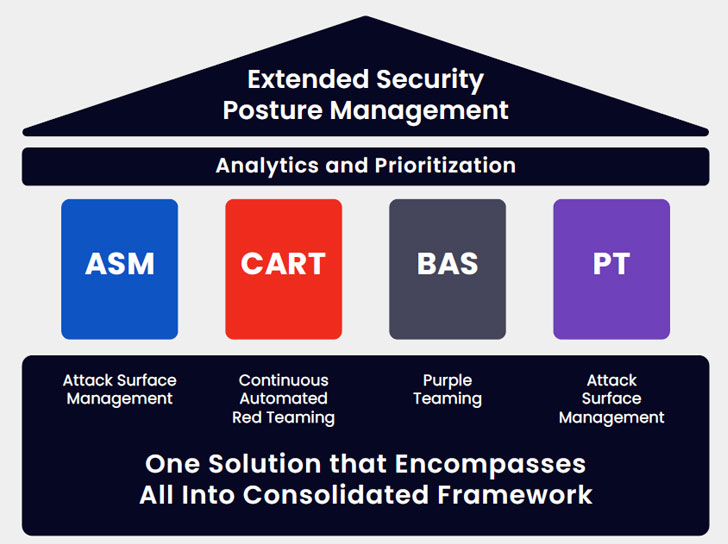
Extended Security Posture Management (XSPM) is a multilayered
process combining the capabilities of Attack Surface Management
(ASM), Breach and Attack Simulation (BAS), Continuous Automated Red
Teaming (CART), and Purple Teaming to continuously evaluate and
score the infrastructure’s overall cyber resiliency.
This up-to-date comprehensive snapshot of the active security
posture, combined with detailed remediation process
recommendations, is conducive to making rational business decisions
based on hard data.
Using the granular evaluation of each individual tool and of the
security control configuration, an XSPM solution provides granular
information about each solution used, the eventual overlap between
two or more solutions and the remaining security gaps. It then
provides detailed recommendations about the remediation process for
each gap and optimization options for identified overlaps.
The Advantage of a Consolidated, Extensive Baseline
Security teams are systematically impressed by the difference in
having actionable data made, both in improving the security posture
and in rationalizing cybersecurity spending.
XSPM helps the security team to deal with the constant content
configuration churn and leverages telemetry to help identify the
gaps in security by generating up-to-date emerging threats feeds
and providing additional test cases emulating TTPs that attackers
would use, saving DevSocOps the time needed to develop those test
cases. When running XSPM validation modules, knowing that the tests
are timely, current, and relevant enables reflecting on the
efficacy of security controls and understanding where to make
investments to ensure that the configuration, hygiene and posture
are maintained through the constant changes in the environment.
By providing visibility and maximizing relevancy, XSPM helps
verify that each dollar spent benefits risk reduction and tool
efficacy through baselining and trending and automatically
generating reports containing detailed recommendations covering
security hardening and tool stack optimization; it dramatically
facilitates conversations with the board.
The switch from infrequent to regular testing, made possible by
automation, enables both the continuous baseline variability
monitoring and the quantified calculation of ROI achieved through
tool stack rationalization.
Furthermore, it enables creating attack-based vulnerability
management by leveraging the results to prioritize patching.
As a bonus, checking an environment’s ability to withstand the
latest attacks can be done almost at a click, and, if needed,
recommended mitigation processes can be pushed forward in the
prioritized patching schedule.
George Washington’s adage “The best defense is a good
offense” definitely applies to cybersecurity, and the
continuous offense is the only way to stay ahead of the attackers’
progress consistently.
Note: This article was written by Arien Seghetti, Solution
Architect at Cymulate. For more information,
visit www.cymulate.com and
register for a Free Trial.[2][3][4]
References
- ^
over
half of SOC centers are overrun with redundant security tools
(newsroom.trendmicro.com) - ^
Cymulate
(cymulate.com) - ^
www.cymulate.com
(cymulate.com) - ^
Free
Trial (cymulate.com)
Read more https://thehackernews.com/2021/12/how-extended-security-posture.html