
A new Iranian threat actor has been discovered exploiting a
now-addressed critical flaw in the Microsoft Windows MSHTML
platform to target Farsi-speaking victims with a new
PowerShell-based information stealer designed to harvest extensive
details from infected machines.
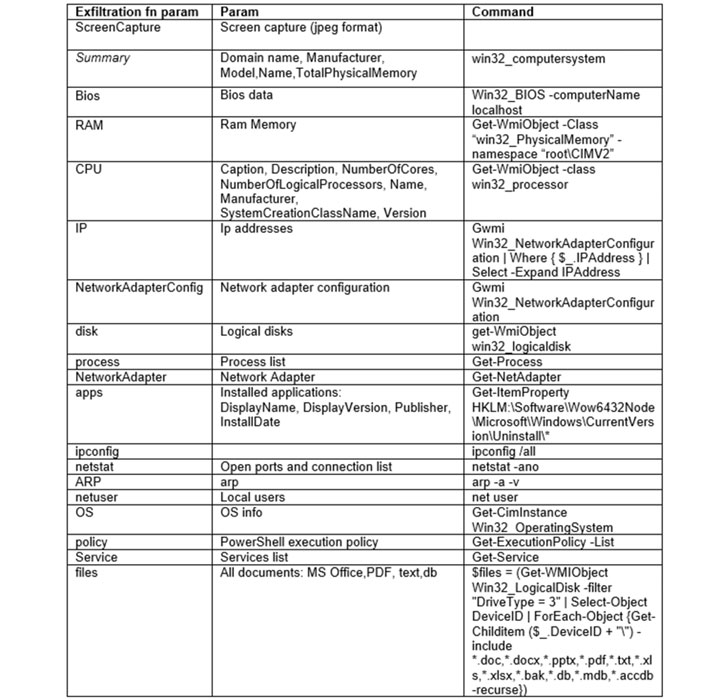
“[T]he stealer is a PowerShell script, short with powerful
collection capabilities — in only ~150 lines, it provides the
adversary a lot of critical information including screen captures,
Telegram files, document collection, and extensive data about the
victim’s environment,” SafeBreach Labs researcher Tomer Bar
said[1]
in a report published Wednesday.
Nearly half of the targets are from the U.S., with the
cybersecurity firm noting that the attacks are likely aimed at
“Iranians who live abroad and might be seen as a threat to Iran’s
Islamic regime.”
The phishing campaign, which began in July 2021, involved the
exploitation of CVE-2021-40444, a remote code execution flaw that
could be exploited using specially crafted Microsoft Office
documents. The vulnerability was patched[2]
by Microsoft in September 2021, weeks after reports[3]
of active exploitation emerged in the wild.
“An attacker could craft a malicious ActiveX control to be used
by a Microsoft Office document that hosts the browser rendering
engine. The attacker would then have to convince the user to open
the malicious document. Users whose accounts are configured to have
fewer user rights on the system could be less impacted than users
who operate with administrative user rights,” the Windows maker had
noted.
The attack sequence described by SafeBreach begins with the
targets receiving a spear-phishing email that comes with a Word
document as an attachment. Opening the file triggers the exploit
for CVE-2021-40444, resulting in the execution of a PowerShell
script dubbed “PowerShortShell” that’s capable of hoovering
sensitive information and transmitting them to a
command-and-control (C2) server.
While infections involving the deployment of the info-stealer
were observed on September 15, a day after Microsoft issued patches
for the flaw, the aforementioned C2 server was also employed to
harvest victims’ Gmail and Instagram credentials as part of two
phishing campaigns staged by the same adversary in July 2021.
The development is the latest in a string of attacks that have
capitalized on the MSTHML rendering engine flaw, with Microsoft
previously disclosing[4]
a targeted phishing campaign that abused the vulnerability as part
of an initial access campaign to distribute custom Cobalt Strike
Beacon loaders.
References
Read more https://thehackernews.com/2021/11/hackers-using-microsoft-mshtml-flaw-to.html