No fewer than 1,220 Man-in-the-Middle (MitM) phishing websites
have been discovered as targeting popular online services like
Instagram, Google, PayPal, Apple, Twitter, and LinkedIn with the
goal of hijacking users’ credentials and carrying out further
follow-on attacks.
The findings come from a new study[1]
undertaken by a group of researchers from Stony Brook University
and Palo Alto Networks, who have demonstrated a new fingerprinting
technique that makes it possible to identify MitM phishing kits in
the wild by leveraging their intrinsic network-level properties,
effectively automating the discovery and analysis of phishing
websites.
Dubbed “PHOCA[2]” — named after the Latin
word for “seals” — the tool not only facilitates the discovery of
previously unseen MitM phishing toolkits, but also be used to
detect and isolate malicious requests coming from such servers.
Phishing toolkits aim to automate and streamline[3]
the work required by attackers to conduct credential-stealing
campaigns. They are packaged ZIP files that come with ready-to-use
email phishing templates and static copies of web pages from
legitimate websites, allowing threat actors to impersonate the
targeted entities in a bid to trick unsuspecting victims into
disclosing private information.
But the increasing adoption of two-factor authentication
(2FA[4]) by online services in
recent years meant that these traditional phishing toolkits can no
longer be an effective method to break into accounts protected by
the extra layer of security. Enter MitM phishing toolkits, which go
a step further by altogether obviating the need for maintaining
“realistic” web pages.
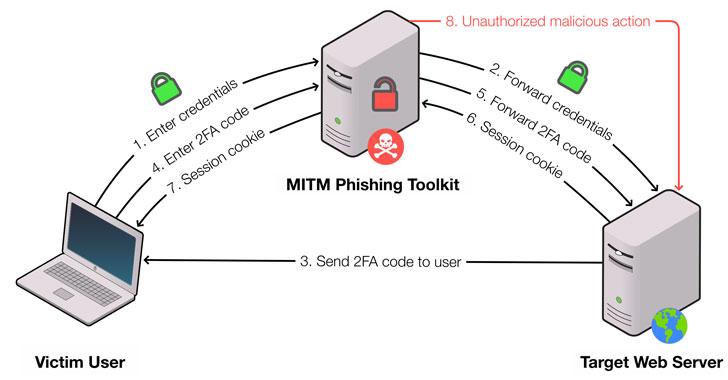
A MitM phishing kit enables fraudsters to sit between a victim
and an online service. Rather than setting up a bogus website
that’s distributed via spam emails, the attackers deploy a
fraudulent website that mirrors the live content of the target
website and acts as a conduit to forward requests and responses
between the two parties in real-time, thus permitting the
extraction of credentials and session cookies from
2FA-authenticated accounts.
“They function as reverse proxy servers, brokering communication
between victim users and target web servers, all while harvesting
sensitive information from the network data in transit,” Stony
Brook University researchers Brian Kondracki, Babak Amin Azad,
Oleksii Starov, and Nick Nikiforakis said[5]
in an accompanying paper.
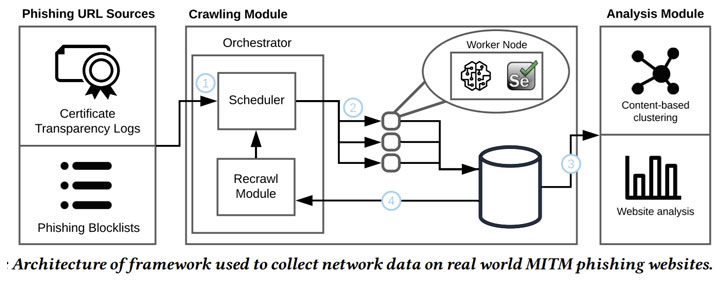
The method devised by the researchers involves a machine
learning classifier that utilizes network-level features such as
TLS[6]
fingerprints and network timing discrepancies to classify phishing
websites hosted by MitM phishing toolkits on reverse proxy servers.
It also entails a data-collection framework that monitors and
crawls suspicious URLs from open-source phishing databases like
OpenPhish[7] and PhishTank[8], among others.
The core idea is to measure the round-trip time (RTT[9]) delays that arise out
of placing a MitM phishing kit, which, in turn, increases the
duration from when the victim browser sends a request to when it
receives a response from the target server owing to the fact that
the reverse proxy mediates the communication sessions.
“As two distinct HTTPS sessions must be maintained to broker
communication between the victim user and target web server, the
ratio of various packet RTTs, such as a TCP SYN/ACK request and
HTTP GET request, will be much higher when communicating with a
reverse proxy server than with an origin web server directly,” the
researchers explained. “This ratio is further magnified when the
reverse proxy server intercepts TLS requests, which holds true for
MitM phishing toolkits.”
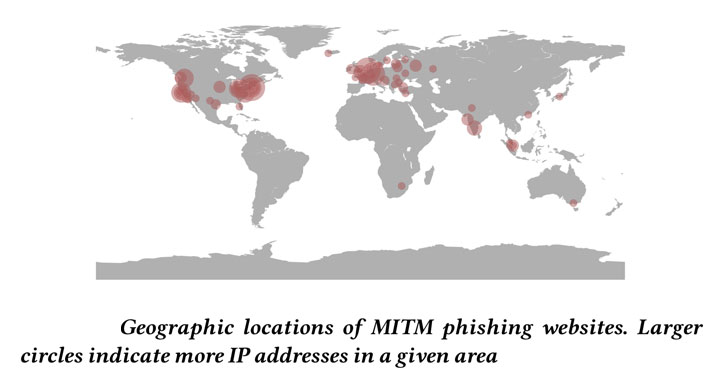
In an experimental evaluation that lasted 365 days between March
25, 2020 and March 25, 2021, the study uncovered a total of 1,220
sites as operated using MitM phishing kits that were scattered
primarily across the U.S. and Europe, and relied on hosting
services from Amazon, DigitalOcean, Microsoft, and Google. Some of
the brands that were most targeted by such kits include Instagram,
Google, Facebook, Microsoft Outlook, PayPal, Apple, Twitter,
Coinbase, Yahoo, and LinkedIn.
“PHOCA can be directly integrated into current web
infrastructure such as phishing blocklist services to expand their
coverage on MitM phishing toolkits, as well as popular websites to
detect ma- licious requests originating from MitM phishing
toolkits,” the researchers said, adding that uniquely identifying
MitM phishing toolkits can “enhance the ability of web-service
providers to pinpoint malicious login requests and flag them before
authentication is completed.”
References
Read more https://thehackernews.com/2021/11/researchers-demonstrate-new-way-to.html