Cybersecurity researchers on Monday took the wraps off a new
Android trojan that takes advantage of accessibility features on
the devices to siphon credentials from banking and cryptocurrency
services in Italy, the U.K., and the U.S.
Dubbed “SharkBot[1]” by Cleafy, the malware
is designed to strike a total of 27 targets — counting 22 unnamed
international banks in Italy and the U.K. as well as five
cryptocurrency apps in the U.S. — at least since late October 2021
and is believed to be in its early stages of development, with no
overlaps found to that of any known families.
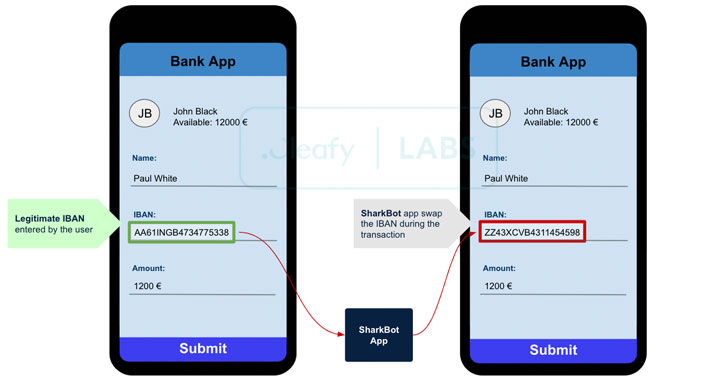
“The main goal of SharkBot is to initiate money transfers from
the compromised devices via Automatic Transfer Systems (ATS)
technique bypassing multi-factor authentication mechanisms (e.g.,
SCA),” the researchers said in a report.
“Once SharkBot is successfully installed in the victim’s device,
attackers can obtain sensitive banking information through the
abuse of Accessibility Services, such as credentials, personal
information, current balance, etc., but also to perform gestures on
the infected device.”

Masquerading as a media player[2], live TV, or data
recovery apps, SharkBot, like its other malware counterparts
TeaBot[3]
and UBEL[4], repeatedly prompts
users with rogue pop-ups to grant it wide permissions only to steal
sensitive information. Where it stands apart is the exploitation of
accessibility settings to carry out ATS attacks, which allow the
operators to “auto-fill fields in legitimate mobile banking apps
and initiate money transfers from the compromised devices to a
money mule network controlled by the [threat actor].”
The modus operandi[5]
effectively obviates the need for enrolling a new device to perform
fraudulent activities, while also bypassing two-factor
authentication mechanisms put in place by the banking
applications.
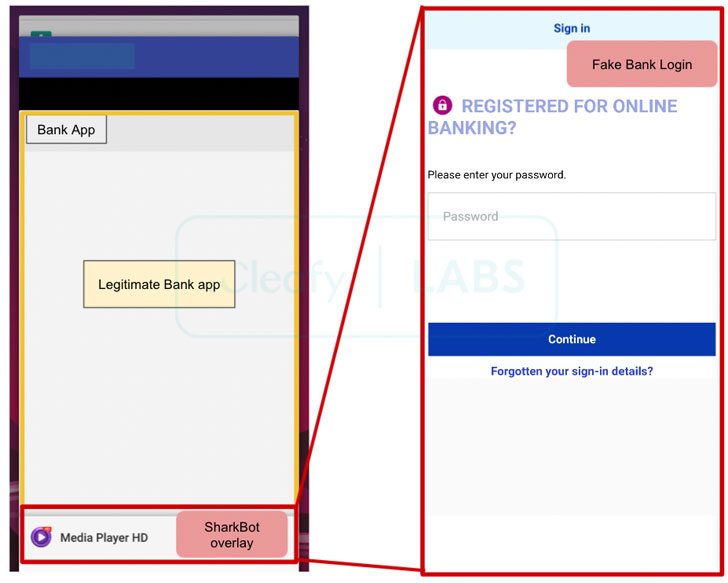
In addition, the malware comes with all features now observed
across all Android banking trojans[6], such as the ability to
perform overlay attacks to steal login credentials and credit card
information, intercept legitimate banking communications sent
through SMS, enable keylogging, and obtain full remote control of
the compromised devices.
SharkBot is also notable for the steps it takes to evade
analysis and detection, including running emulator checks,
encrypting command-and-control communications with a remote server,
and hiding the app’s icon from the home screen post-installation.
No samples of the malware have been detected on the official Google
Play Store, implying that the malicious apps are installed on the
users’ devices either via sideloading or social engineering
schemes.
The discovery of SharkBot in the wild shows “how mobile malwares
are quickly finding new ways to perform fraud, trying to bypass
behavioural detection countermeasures put in place by multiple
banks and financial services during the last years,” the
researchers said.
References
- ^
SharkBot
(www.cleafy.com) - ^
a media
player (www.virustotal.com) - ^
TeaBot
(thehackernews.com) - ^
UBEL
(thehackernews.com) - ^
modus
operandi (malpedia.caad.fkie.fraunhofer.de) - ^
Android
banking trojans (thehackernews.com)
Read more https://thehackernews.com/2021/11/sharkbot-new-android-trojan-stealing.html