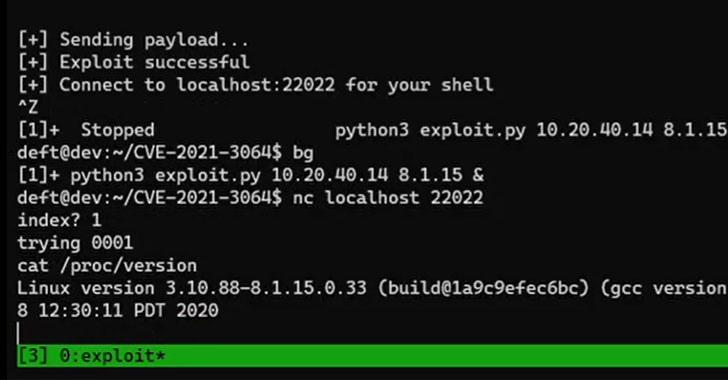
A new zero-day vulnerability has been disclosed in Palo Alto
Networks GlobalProtect VPN that could be abused by an
unauthenticated network-based attacker to execute arbitrary code on
affected devices with root user privileges.
Tracked as CVE-2021-3064 (CVSS score: 9.8), the security
weakness impacts PAN-OS 8.1 versions earlier than PAN-OS 8.1.17.
Massachusetts-based cybersecurity firm Randori has been credited
with discovering and reporting the issue.
“The vulnerability chain consists of a method for bypassing
validations made by an external web server (HTTP smuggling) and a
stack-based buffer overflow,” Randori researchers said[1]. “Exploitation of the
vulnerability chain has been proven and allows for remote code
execution on both physical and virtual firewall products.”
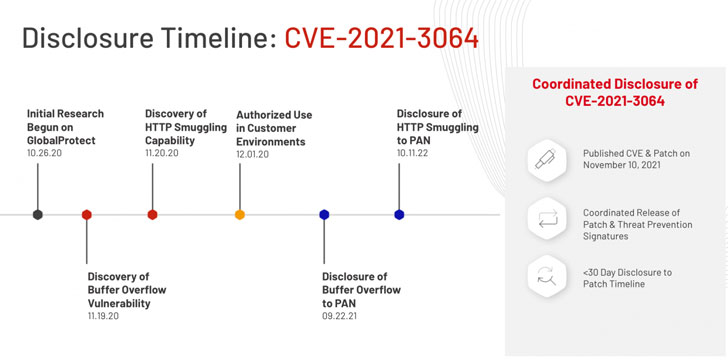
Technical details related to CVE-2021-3064 have been withheld
for 30 days to prevent threat actors from abusing the vulnerability
to stage real-world attacks.
The security bug stems from a buffer overflow that occurs while
parsing user-supplied input. Successful exploitation of the flaw
necessitates that the attacker strings it with a technique known as
HTTP smuggling[2]
to achieve remote code execution on the VPN installations, not to
mention have network access to the device on the GlobalProtect
service default port 443.
“A memory corruption vulnerability exists in Palo Alto Networks
GlobalProtect portal and gateway interfaces that enables an
unauthenticated network-based attacker to disrupt system processes
and potentially execute arbitrary code with root privileges,” Palo
Alto Networks said[3]
in an independent advisory. “The attacker must have network access
to the GlobalProtect interface to exploit this issue.”
In light of the fact that VPN devices are lucrative targets[4]
for malicious actors, it’s highly recommended that users move
quickly to patch the vulnerability. As a workaround, Palo Alto
Networks is advising affected organizations to enable threat
signatures for identifiers 91820 and 91855 on traffic destined for
GlobalProtect portal and gateway interfaces to prevent any
potential attacks against CVE-2021-3064.
References
- ^
said
(www.randori.com) - ^
HTTP
smuggling (thehackernews.com) - ^
said
(security.paloaltonetworks.com) - ^
lucrative targets
(thehackernews.com)
Read more https://thehackernews.com/2021/11/palo-alto-warns-of-zero-day-bug-in.html