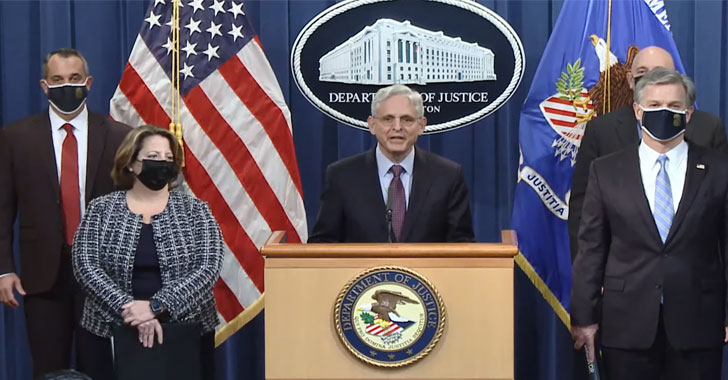
The U.S. government on Monday charged a Ukrainian suspect,
arrested in Poland last month, with deploying REvil ransomware to
target multiple businesses and government entities in the country,
including perpetrating the attack against software company Kaseya,
marking the latest action to crack down on the cybercrime group and
curb further attacks.
According to unsealed court documents, 22-year-old Yaroslav
Vasinskyi is alleged[1]
to have been part of the ransomware operation at least since March
2019 and deployed about 2,500 attacks against businesses worldwide.
Vasinskyi (aka Profcomserv, Rabotnik, Rabotnik_New, Yarik45,
Yaraslav2468, and Affiliate 22) was apprehended at the Polish
border on October 8 after an international arrest warrant was
issued at the behest of U.S. authorities.
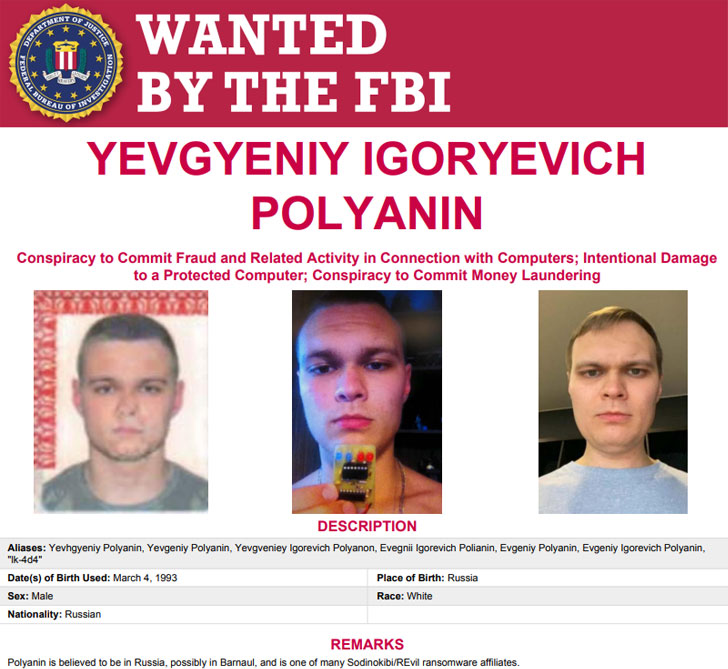
In another major development, the Justice Department disclosed
the seizure of $6.1 million in alleged ransomware payments received
by Russian national Yevgeniy Polyanin, who is currently at large
and has been accused of conducting REvil ransomware attacks against
multiple businesses and government entities in
Texas[2] dating back to August
16, 2019.
Vasinskyi and Polyanin have been charged with conspiracy to
commit fraud and related activity in connection with computers,
substantive counts of damage to protected computers, and conspiracy
to commit money laundering. If convicted of all counts, both the
defendants face a maximum penalty of 115 and 145 years in prison,
respectively.
“Ransomware can cripple a business in a matter of minutes. These
two defendants deployed some of the internet’s most virulent code,
authored by REvil, to hijack victim computers,” said Acting U.S.
Attorney Chad E. Meacham for the Northern District of Texas in a
statement. “The Department will delve into the darkest corners of
the internet and the furthest reaches of the globe to track down
cyber criminals.”
The latest development comes amid a flurry of law enforcement
activity orchestrated by Europol under Operation GoldDust[3], which resulted in the
arrests of six other REvil ransomware affiliates besides Vasinskyi
across Romania, Kuwait, and South Korea. The REvil ransomware gang
is believed to have netted more than $200 million since it started
operations and globally encrypted at least 175,000 computers.
Coinciding with the arrests, the U.S. government also announced[4]
it’s offering a reward of up to $10 million[5] for information leading
to the identification or location of key leaders behind the REvil
ransomware, in addition to paying out up to $5 million for
information leading to the arrest or conviction of individuals,
located in any country, participating in REvil ransomware
attacks.
Furthermore, the U.S. Treasury Department imposed sanctions[6]
against Chatex, a virtual currency exchange, for “facilitating
financial transactions for ransomware actors,” following a similar
designation against Russian cryptocurrency exchange SUEX[7]
in September 2021.
“Analysis of Chatex’s known transactions indicate that over half
are directly traced to illicit or high-risk activities such as
darknet markets, high-risk exchanges, and ransomware,” the
department said. “Chatex has direct ties with SUEX OTC, S.R.O.
(Suex), using Suex’s function as a nested exchange to conduct
transactions.”
The arrests and the sanctions are part of a larger push to
fight against ransomware attacks[8], which have accelerated
in frequency and scale this year, putting critical infrastructure
at risk and causing millions in damages, prompting international
authorities to effectively respond to such attacks, while also
countering the abuse of cryptocurrency channels to launder ransom
payments.
References
- ^
alleged
(www.justice.gov) - ^
businesses and government entities in
Texas (thenextweb.com) - ^
Operation GoldDust
(thehackernews.com) - ^
announced
(www.state.gov) - ^
reward
of up to $10 million (thehackernews.com) - ^
imposed
sanctions (home.treasury.gov) - ^
SUEX
(thehackernews.com) - ^
fight
against ransomware attacks
(thehackernews.com)